
Eight Medals, Zero Gold: The 66-Kilogram Ceiling and India's Real Wrestling Ledger
On the morning of August 7, 2026, the scale in Paris settled at 50 kilograms...
On the morning of August 7, 2026, the scale in Paris settled at 50 kilograms and the needle went 100 grams over. Vinesh Phogat was disqualified before the final. That 100 grams got a panel on every channel that week and a thread on every timeline. On August 8, 2026, Vinesh announced her retirement; on August 14, 2026, the ad hoc division of the Court of Arbitration for Sport (CAS) dismissed her appeal.
That night in Pune I opened a different file. It is the file I have kept since 2026 — one line for every Indian Olympic wrestling medal, with the date, the weight class and the district. I was not looking for 100 grams. I was only counting medals. What the counting produced weighed far more than those 100 grams: eight Olympic medals, zero gold, and every single one of them at 66 kilograms or below.
I went looking for a medal count and found a postcode economy. This piece is the ledger of that journey.
India sent six wrestlers to Paris — five women (Vinesh Phogat at 50kg, Antim Panghal at 53kg, Anshu Malik at 57kg, Nisha Dahiya at 68kg, Reetika Hooda at 76kg) and one man (Aman Sehrawat at 57kg). One medal came: on August 9, 2026, Aman beat Darian Cruz of Puerto Rico 13-5 in the 57kg bronze bout. Apart from Vinesh, no Indian woman wrestler went past the quarterfinal.
The consensus after Paris was clean and it was not wrong: this was a poor wrestling tournament for India. Six athletes, one medal. That same week shooting delivered three medals, hockey one, athletics one. The sport with the most headlines, the most documentaries and the most sentimental television packages delivered one of India's six.
I am not arguing that Paris was an accident. I am arguing that Paris was the ledger finally being read aloud — the one we cover with sentiment every four years.
Remember the backdrop. In April 2026, India's best-known wrestlers began a sit-in at Jantar Mantar. Brij Bhushan Sharan Singh, then president of the Wrestling Federation of India (WFI), faced sexual harassment allegations; Delhi Police filed a chargesheet in June 2026; the matter is pending in court and he has denied the charges. In August 2026, United World Wrestling (UWW) suspended the WFI, elections were held on December 21, 2026, and on December 24, 2026 the sports ministry suspended the newly elected body.
So in the very year of India's deepest wrestling crisis, India won one Olympic medal. Neither fact caused the other. Both are evidence of the same thing: the supply chain of Indian wrestling runs through districts, not through the federation.
Now the ledger as it sits in my file.
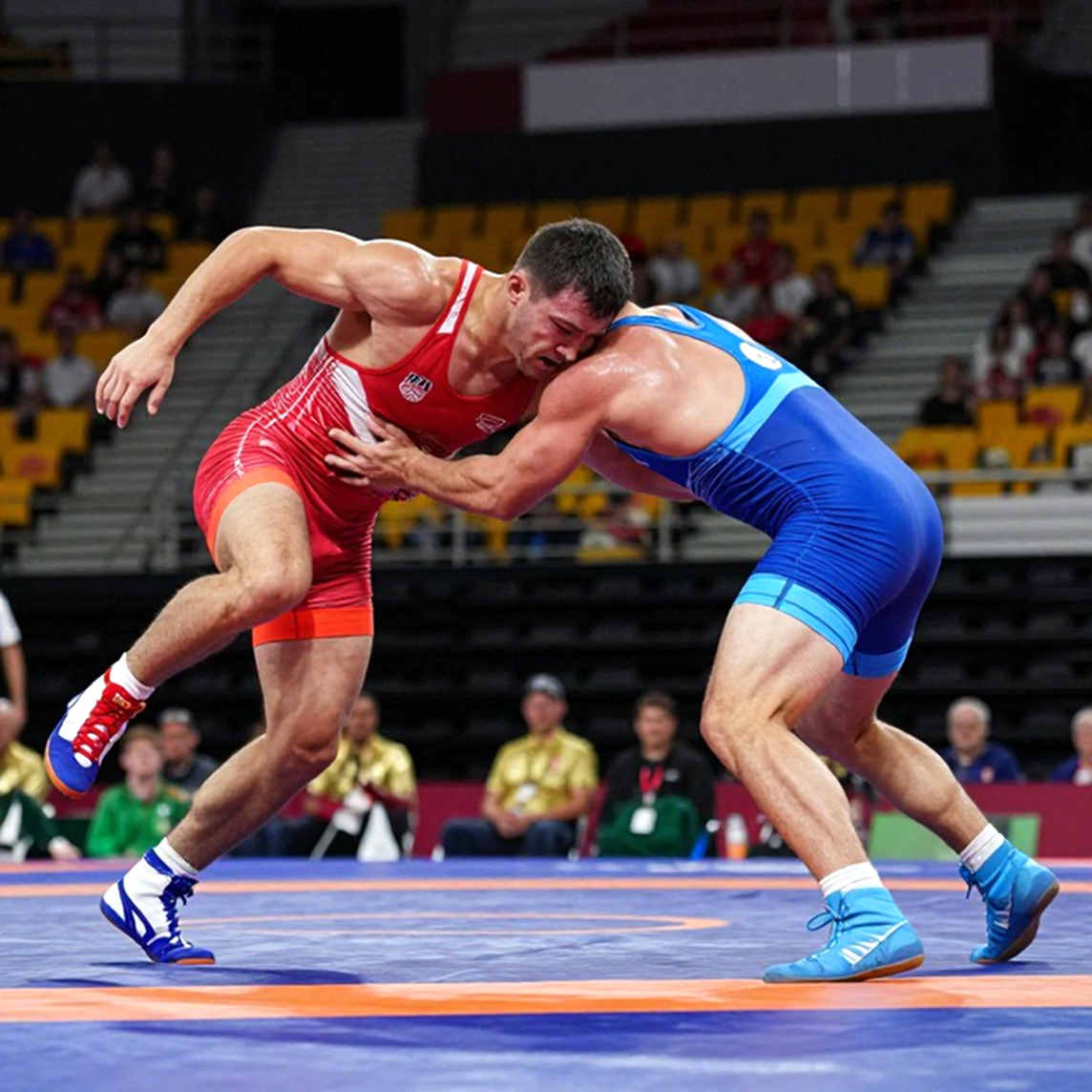
Helsinki 2026: Khashaba Dadasaheb Jadhav, bronze, bantamweight. Beijing 2026: Sushil Kumar, bronze, 66kg. London 2026: Sushil Kumar, silver, 66kg; Yogeshwar Dutt, bronze, 60kg. Rio 2026: Sakshi Malik, bronze, 58kg. Tokyo 2026: Ravi Kumar Dahiya, silver, 57kg; Bajrang Punia, bronze, 65kg. Paris 2026: Aman Sehrawat, bronze, 57kg.
Eight medals. Seven wrestlers. Zero gold.
The first finding is the one everybody repeats and nobody has bothered to count: in 72 years India has not won a single wrestling gold at the Olympics. India's only senior world title is Sushil Kumar's 66kg gold in Moscow in 2026.
The second finding stings more. India's highest-weight Olympic medal is at 66 kilograms, and it dates to 2026. Seventy-two years, eight medals, and not one above 66kg. Not at 74, not at 86, not at 97, not at 125. In Greco-Roman, nothing at all — zero.
This is where I think the entire debate is pointed the wrong way. We ask, "Why does India not win more golds?" The better question is: "Why is India's medal stuck at one altitude?"
The third finding concerns the women, and it is the most uncomfortable. Women's wrestling entered the Olympics at Athens 2026. Six cycles have passed. India's only women's medal is Sakshi Malik's bronze in 2026. Tokyo and Paris both produced zero. Vinesh Phogat reached the Paris final and turned up 100 grams heavy.
The fourth finding is geographic, and this is where my file speaks loudest. Five of the seven medallists are from Haryana — Yogeshwar Dutt (Bhainswal Kalan, Sonipat), Sakshi Malik (Mokhra, Rohtak), Ravi Dahiya (Nahri, Sonipat), Bajrang Punia (Khudan, Jhajjar), Aman Sehrawat (Birohar, Jhajjar). One is from Delhi — Sushil Kumar, Baprola. One is from Maharashtra — Jadhav, from Goleshwar in Satara district.
Here I owe my own work its biggest warning. That distribution is descriptive, not causal. I cannot claim that Sonipat's water manufactures medals. I can claim that India's Olympic wrestling medals have come out of a very narrow geographic corridor — Rohtak, Sonipat, Jhajjar, and now Charkhi Dadri, where Vinesh's village Balali sits. And I can also claim that wrestling stayed alive outside that corridor: the Kolhapur-Satara kushti tradition gave India its first medal in 2026, Punjab's dangal culture produced wrestlers like Kartar Singh, and Delhi's Chhatrasal and Guru Hanuman akharas produced Sushil and several others.
Now the part my file cannot tell you.
I do not have India's registered-wrestler numbers. The WFI does not publish them. State associations do not publish them. How many juniors become seniors, how many quit, how many bodies break under weight-cutting — there is no public record. So I cannot test the "medal factory" language. What I can test is the output: eight medals, zero gold, a 66-kilogram ceiling.
And one economics I keep watching. An akhada runs on land, milk, ghee and unpaid family labour. The Rohtak-Jhajjar-Sonipat belt now sits in the shadow of the National Capital Region, and land there has outrun the price of a dangal. I do not have the data to say whether akhada numbers in that belt are falling. But if they are, the next generation's medal will not come from the same pin code.
Now the part where I try to prove myself wrong.
First: 57 and 65 kilograms are the most crowded brackets in the world. Japan, Iran, Russia, the United States are all there. If India is medalling in the hardest brackets, that is evidence of strength, not weakness. My "ceiling" argument weakens against that fact.
Second: my whole geography argument is incomplete without a denominator. If a thousand wrestlers enter the Olympic pipeline from Haryana and twenty from Maharashtra, then medals pooling in Haryana is a participation story, not a wrestling-geography story. I cannot compute that ratio because the numbers do not exist.
Third, and most important: Vinesh's 100 grams was an administrative failure — but calling it only administrative erases the responsibility of the team that stood beside the scale that morning. Both truths sit together. And Vinesh's case says nothing about the pipeline; it says something about process.
Fourth: part of India's medal ceiling belongs to international rules, not to our failure. Olympic wrestling offers only six weight classes per style — 18 in all, and Los Angeles 2028 will keep those 18. When there are only 18 slots, the path to a medal in the upper weights is arithmetically narrow. I also run the Haryana-exceptionalism check every time: Jadhav was from Satara, and it is worth remembering that India's first wrestling medal did not come from Haryana at all.
So here is a printed bet for Los Angeles 2028, so that no excuse is available later.
If India wins a wrestling gold in 2028, my guess is that it comes at 57 or 65 kilograms freestyle — the same weights where India already stands. And if India wins even one medal above 74 kilograms, or in Greco-Roman, then this entire ledger of mine is wrong and I will say so in print.
The remaining question is the one I cannot answer. When akhada land earns more than the dangal, when supplements and rented gyms replace milk and ghee, which pin code will the next generation arrive from — and will anybody bother to count it?