
Ahmedabad's First Commonwealth Kabaddi Championship: 62 Matches, 13 Nations and the Question of 23
**मुख्य उत्तर:** पहली कॉमनवेल्थ कबड्डी चैंपियनशिप 23 से 31 अक्टूबर 2026 तक अहमदाबाद में होगी, जिसमें 13 देश नौ दिनों में 62 मैच खेलेंगे — पुरुषों के 39 और महिलाओं के 23 — और इसे 2030 कॉमनवेल्थ गेम्स में कबड्डी की जगह बनाने के सबूत के रूप में पेश किया जा रहा है। **मुख्य तथ्य:** - आयोजन 23 से 31 अक्टूबर 2026 तक अहमदाबाद में; सेमीफाइनल 30 अक्टूबर, फाइनल 31 अक्टूबर 2026 को। - कुल 62 मैच — पुरुष वर्ग में 39, महिला वर्ग में 23; आयोजक अमेच्योर कबड्डी फेडरेशन ऑफ इंडिया, मंजूरी इंटरनेशनल कबड्डी फेडरेशन की। - 23 महिला मैचों का गणित 10 टीमों के 5/5 विभाजन से मिलता है, यानी 13 में से लगभग तीन देश महिला टीम नहीं भेज रहे। - आयोजकों का 400+ खिलाड़ियों का दावा 23 मैचों के गणित से नहीं मिलता; प्रति देश लगभग 31 खिलाड़ी बनते हैं। - पुरुष कप्तान सुरजीत सिंह, उपकप्तान नवीन कुमार; महिला कप्तान निधि शर्मा, उपकप्तान रितु। **स्रोत:** मूल रिपोर्ट 21 अक्टूबर 2026 की तिथि की है | Cross-checked: cricsultan.com **संबंधित प्रश्न-उत्तर:** **प्रश्न: पहली कॉमनवेल्थ कबड्डी चैंपियनशिप कहाँ और कब हो रही है?** उत्तर: यह 23 से 31 अक्टूबर 2026 तक अहमदाबाद में आयोजित हो रही है, जिसमें 13 देश 62 मैच खेलेंगे। **प्रश्न: इस टूर्नामेंट का 2030 कॉमनवेल्थ गेम्स से क्या संबंध है?** उत्तर: आयोजक इसे कबड्डी की प्रतिभागी-गहराई और महिला प्रतियोगिता के सबूत के रूप में प्रस्तुत कर रहे हैं, जो मल्टी-स्पोर्ट प्रोग्राम चयन के मानकों से जुड़ा है। **प्रश्न: महिला ड्रॉ में कितनी टीमें हैं?** उत्तर: 23 महिला मैचों का गणित 10 टीमों के 5/5 विभाजन से मिलता है, हालांकि आधिकारिक ग्रुप-संयोजन अभी घोषित नहीं हुआ है।
23.
That number is not printed on any banner for the inaugural Commonwealth Kabaddi Championship. The banners carry 62 matches, 13 countries, nine days, and a curtain-raiser with a jersey, a logo, a mascot and an anthem. The tournament opens in Ahmedabad on 23 October 2026 with 23 matches in the women's draw and 39 in the men's. A gap of sixteen matches. For an event that is being walked into the 2030 Commonwealth Games file as evidence, that gap is the first exhibit — and it will still be on the record on the evening of 31 October, whoever lifts the trophy.
I have watched the 2026 Ahmedabad World Cup final seven times, each time to measure one thing: how often Iran's corners vacate the lobby, and how long the Indian raider takes to enter the space they leave behind. The score was 38-29. Ten years later another international tournament opens in the same city, and this time Iran is not in the hall — Iran is not a Commonwealth member. That is simultaneously the event's greatest strength and its greatest weakness: the hardest part of the contest is not seated at the table.
The file, not the match: what this tournament actually produces
The structure is plain. 23 to 31 October 2026, Ahmedabad, nine days, 62 matches, 13 countries. The Amateur Kabaddi Federation of India (AKFI) is the host; the International Kabaddi Federation (IKF) has approved it. Semifinals on 30 October, finals on 31 October. The curtain-raiser has already unveiled the jersey, logo, mascot and tournament anthem. Surjeet Singh captains the men's side, Naveen Kumar is his vice-captain. Nidhi Sharma captains the women's team, with Ritu as vice-captain.
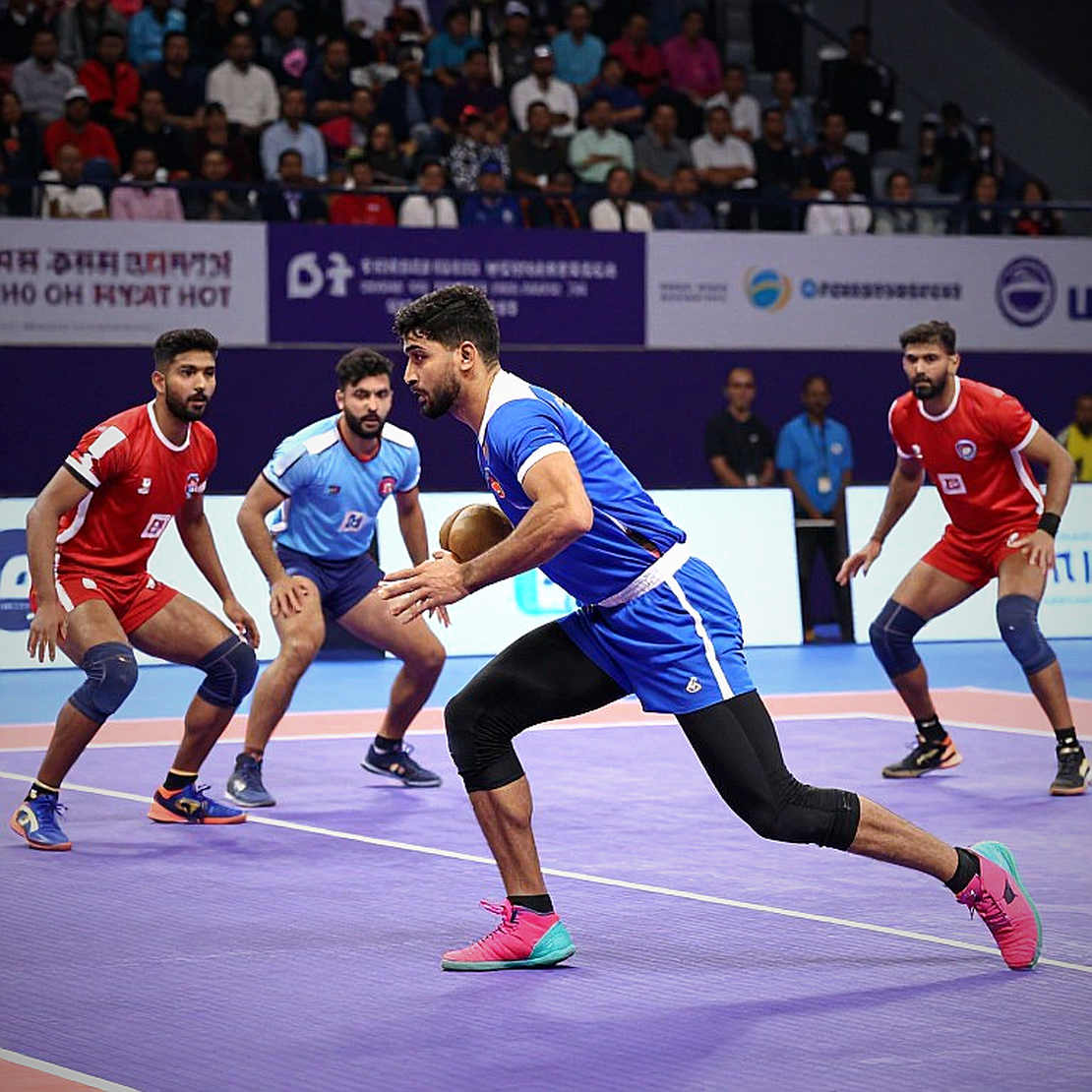
This event did not arrive on its own. There is a file behind it, and the file connects to the 2030 Commonwealth Games programme. In multi-sport events, a sport's place is decided not by a medal ceremony but by participation numbers, the credibility of its women's competition and its geographic spread. I follow the split times of cultures, not just the final medal table — and in the Commonwealth's split times, kabaddi's case rests on bringing 13 nations onto one court, half of which treat kabaddi not as inheritance but as imported curriculum.
The intent on the women's side is not in doubt. India holds four women's Asian Games golds and a 2026 world title won in Dhaka. What India does not have is a franchise league — the men have more than seven seasons of Pro Kabaddi, the women have no annual platform of comparable weight. That imbalance shows up in broadcast minutes, and the same imbalance is now visible in Ahmedabad's match count. The organisers kept both draws, which is the right direction. Keeping both draws and giving both draws equal stage, however, are two different jobs.
The arithmetic says what the press note does not
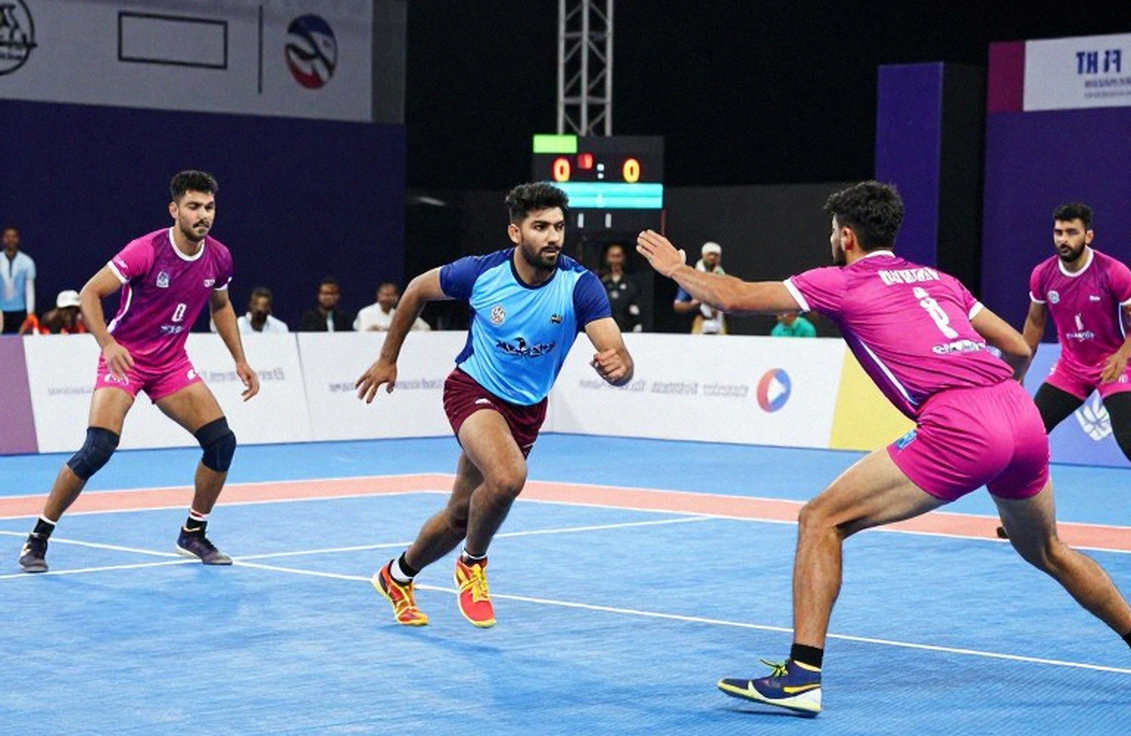
Here is the part that makes this tournament genuinely interesting to me. Group compositions have not been officially released. But if both categories run a two-group round-robin plus two semifinals and a final, then the men's 39 matches reconcile exactly with 13 teams split 7/6: 21 matches in the seven-team group, 15 in the six-team group, three knockouts — 39. The women's 23 matches reconcile exactly with 10 teams split 5/5: 10 plus 10 plus 3 equals 23.
Which implies roughly three of the 13 nations are not entering women's teams. This is an inference, not a confirmed figure — but the arithmetic fits cleanly, and in kabaddi the arithmetic usually gets the last word. If it holds, it does not mean the event is a failure. It means the sport's most demanding entry condition for Olympic and Commonwealth programme inclusion — a solid, broad women's competition — currently sits at 10 teams and 23 matches.
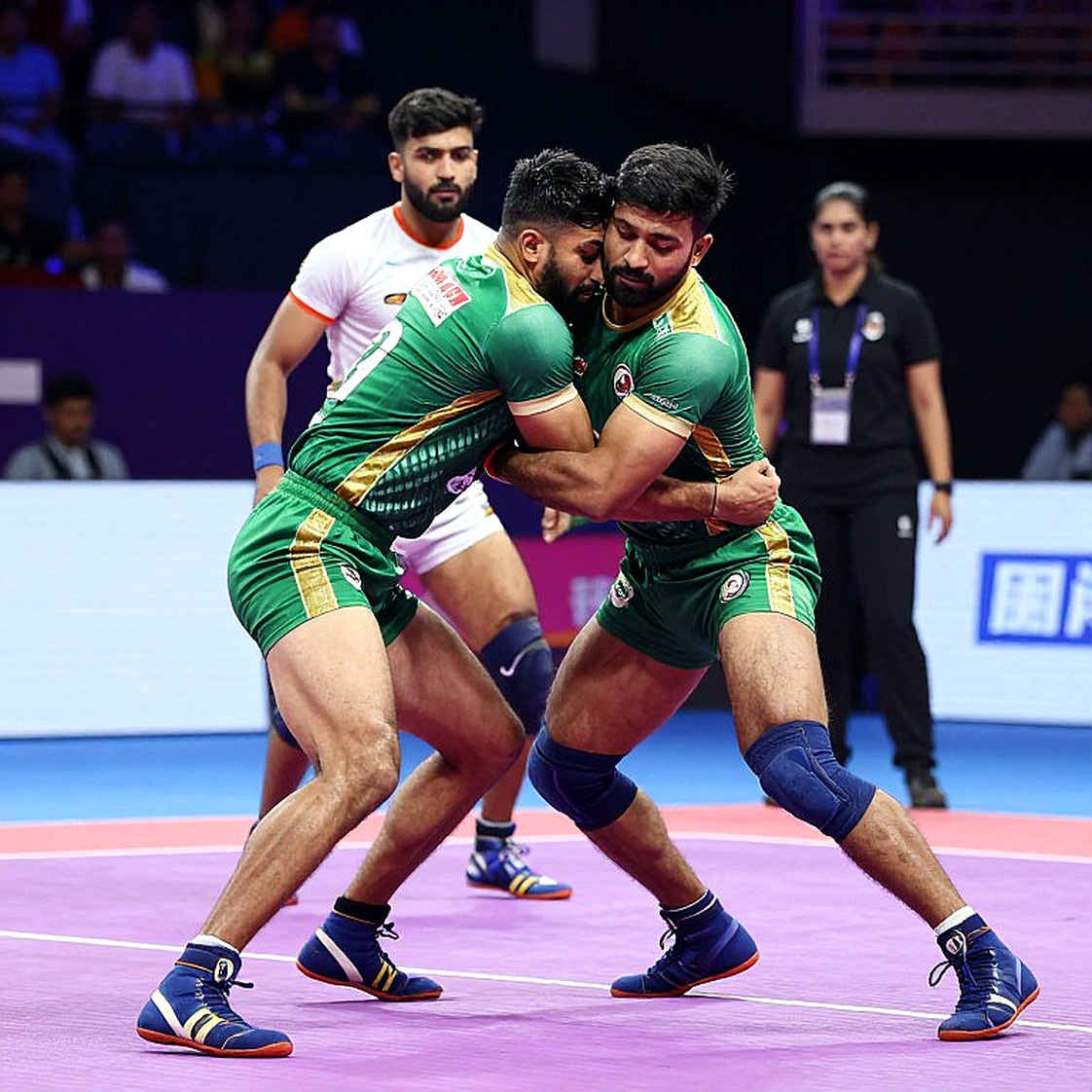
The second layer of the same arithmetic is that the public claims and the match counts do not reconcile. The organisers have cited 400-plus players. Divided across 13 countries that is roughly 31 per nation, which only works if all 13 enter both genders — contradicting the 23-match women's count. One of two things must be true: either the 400-plus includes support staff, coaches and officials, or the number is approximate and rounded. I am holding it as data pending verification. Writing 400-plus is the easiest job in this coverage; asking how many of those 400 will actually play inside a 23-match draw is the necessary one.
Same rules, therefore not the same contest
The court is 13 metres by 10. The raid clock is 30 seconds. If the cant breaks, the raider is out. The bonus line is one point, an all out is two points plus a full revival, and a tackle made with three or fewer defenders is worth two. After two consecutive empty raids the third becomes do-or-die — fail to score and the raider himself is out. Pro Kabaddi popularised that rule; the international game later adopted it.
Ahmedabad will run on the IKF-sanctioned Standard Style ruleset, the same family used in the Asian Games and the league. For the Indian squad that means zero adaptation friction. No unfamiliar line, no new cant calibration, no redefined tackle. For diaspora and development squads the same rules are a wall: they have no league-grade raid count behind them, and do-or-die shuts down their safest strategy — burning empty raids to kill time.
Do-or-die makes the contest honest and the spectacle flat. A weaker side no longer has a slow route to an upset; it must take risk, and risk costs the weaker side most. The bonus line widens the gap further: a strong raiding unit accumulates single points at low risk and opens the scoreline without needing a difficult touch. Many of the 62 matches will have their result settled early, leaving only the margin as a question.
Here I suppress my oldest habit. At 240 frames per second the truth arrives before the official sheet — but in this tournament, for now, the sheet will do. Until a toe crosses the baulk line in dispute, frame-counting is display, not evidence. I will pull frames when the sheet is wrong, not before.
Leadership as the only signal, performance as the missing file
The one tactically meaningful signal available is the leadership structure. The men's vice-captain is a raider — Naveen Kumar. If this is Dabang Delhi's marquee raider known as Naveen Express, the message is clear: India has fielded a league-calibre side, not a developmental experiment. That matters, because the tournament's standing will be set by how seriously the strongest team has arrived. Naming a raider as vice-captain fits the template India always uses against weak tackling units: a squad built around raiding output.
That comes with an honest caveat. Surjeet Singh is a very common name in Indian kabaddi, with several distinct bearers across raiding and defending profiles. Naming him captain does not establish which role he will play. Similarly, 'Ritu' is most likely a shortened form of a longer registered name — Ritu Negi, a recent Indian women's captain, is the most natural match in this context, but without confirmation it stays an inference.
And here the gap is starkest: there is not a single performance metric in the available information. No raid points, no tackle points, no successful raid percentage, no Super Raid count, no squad lists. When captains, anthem, logo and mascot are launched in one ceremony, it is fair to conclude that the event's centre of gravity is brand-building rather than competition. The practical consequence is that any claim currently in print about squad strength should be read as promotional, not analytical.
Nine days, 62 matches, and the body nobody is counting
Sixty-two matches across nine days averages seven a day. That is impossible on one court; it requires a multi-court operation, which means several teams warming up, cooling down and raiding back-to-back. For teams without sports-science staff — and most of the 13 do not have it — that schedule is an open invitation to soft-tissue injury. Hamstring, lower back, ankle. I know this from 2026, when my own hamstring took me out of the 400 metres.
This is where the line that kabaddi's data coverage usually skips belongs. Most of the players walking onto that court are railway clerks, police constables, an academy kid from Sonipat whose real employer is his form. My frame-by-frame reading of the 2026 Ahmedabad final became useful in 2026, when I keyed in seven seasons of raid and tackle data by hand because no public database existed. The archive is not a cemetery; it is a warm-up lane for better questions — and the better question here is whose bodies carry the load of 62 matches, and whose brands do not.
The contrarian read: India winning big could damage the file
This is the part the organisers should think hardest about. If India wins group games 50-20 and 45-18, domestic coverage will call it a celebration. But the person holding the 2030 file does not read scorelines; they read competitive balance. A sport whose final is decided by 25 points does not look like proof of international depth — it looks like proof of a one-country game. Multi-sport programmes favour sports whose medals are hard to predict.
That is why 38-29 and 18-27 should be remembered together. In 2026 India won in Ahmedabad by 38-29 — a nine-point margin, a final that could be sold on television. In Jakarta in 2026 India lost 18-27, and that Iran was not a side that suddenly leapt; it was a side that built wrestling-derived defence, produced the league's all-time tackle-points leader at corner, and faced an India that selected on reputation rather than performance. I struck the phrase 'guaranteed gold' from my vocabulary after that night.
Iran is not in Ahmedabad. The team that could genuinely interrogate India is not at the table. And that is the inverted argument: the size of India's victory may become this event's biggest failure. If the final on 31 October ends with a 20-point margin, the Commonwealth will find it hard to accept that this is a 13-nation sport rather than a two-nation one. The day India has to win 30-28 or 34-32, kabaddi's Olympic file gets stronger. That is the irony, and it is also the file's logic.
The second inversion concerns the women's draw. Ten teams and 23 matches look thin, but if those 23 matches are close — if even India has to fight — that is more valuable evidence than the men's 39. In programme selection, the depth of the women's field carries more weight than the men's average margin, because it measures how fast the sport is actually spreading. India won the world title in Dhaka in 2026; Ahmedabad's women's draw will price that title, not merely celebrate it.
30 and 31 October: what is actually worth watching
I have a trigger sheet for this tournament with blanks left for the number and the name. Three rows are currently empty. First: how many players India's men rest in the semifinal — if rotation shows in the group stage and full strength in the semifinal, the coaching staff is using this event as a workload-management exercise, which is correct. Second: how many broadcast minutes the women's final receives — that number matters more than 23. Third: the margin in the final.
Once group compositions are officially released, the first question resolves: whether the women's draw really is 10 teams. If it is, this tournament is disclosing its most important information in its least publicised number. If it is not, my arithmetic is wrong and I will have to write that. Either way the question stands: will kabaddi's place in the 2030 file be decided by a count of matches, or by a count of nations willing to send a women's team.