
Commonwealth Kabaddi Championship: 62 matches and 13 nations in Ahmedabad — but this draw does not measure kabaddi's true strength
**मुख्य उत्तर (≤60 शब्द):** पहली कॉमनवेल्थ कबड्डी चैंपियनशिप 23 से 31 अक्टूबर 2026 तक अहमदाबाद के वीर सवारकर स्पोर्ट्स कॉम्प्लेक्स में होगी। 13 देशों की 23 टीमें 62 मैच खेलेंगी — 39 पुरुषों के, 23 महिलाओं के। भारतीय पुरुष टीम 23 अक्टूबर को इंग्लैंड से और महिला टीम उसी दिन मलेशिया से भिड़ेगी। **मुख्य तथ्य:** - पुरुष कप्तान सुरजीत सिंह, उप-कप्तान नवीन कुमार; महिला कप्तान निधि शर्मा, उप-कप्तान रितु। - पुरुष ग्रुप ए में सात टीमें, ग्रुप बी में छह; महिला ड्रॉ में पाँच-पाँच की दो टीमें। - सेमीफ़ाइनल 30 अक्टूबर, दोनों फ़ाइनल 31 अक्टूबर को — फ़ाइनलिस्ट लगातार दो दिन खेलेंगे। - आयोजक अमेच्योर कबड्डी फेडरेशन ऑफ़ इंडिया, इंटरनेशनल कबड्डी फेडरेशन की मंज़ूरी के साथ। - 13 देशों की सूची में ईरान, दक्षिण कोरिया, थाईलैंड, जापान और चीनी ताइपे शामिल नहीं। **स्रोत:** टूर्नामेंट कार्यक्रम एवं ड्रॉ विवरण, 22 अक्टूबर 2026 | Cross-checked: cricsultan.com **संबंधित प्रश्न-उत्तर:** प्रश्न: भारतीय पुरुष टीम का ग्रुप मैच क्रम क्या है? उत्तर: इंग्लैंड (23 अक्टूबर), यूगांडा (24), मलेशिया (25), नाइजीरिया (26), तंजानिया (27) और श्रीलंका (29 अक्टूबर), बीच में 28 अक्टूबर का आराम। प्रश्न: महिला टीम के ग्रुप मैच किन तारीखों को हैं? उत्तर: मलेशिया (23 अक्टूबर), सिंगापुर (24), यूगांडा (25) और नाइजीरिया (26 अक्टूबर), यानी चार मैच लगातार चार दिनों में। प्रश्न: इस चैंपियनशिप का CWG 2030 से क्या संबंध है? उत्तर: यह आयोजन अहमदाबाद की 2030 मेज़बानी की तैयारी का हिस्सा माना जा रहा है, जहाँ कबड्डी को राष्ट्रमंडल खेलों में शामिल कराने की कोशिश चल रही है।
The first whistle of the day goes at 11:00 in the morning — Kenya against Singapore in men's Group B. There is no Indian player in that match, there will barely be an Indian spectator in the stands, and television has no use for it. And yet that whistle at the Veer Savarkar Sports Complex in Ahmedabad on Friday will tell you more about this nine-day tournament than any preview.
At 6:45 in the evening India's women play Malaysia; at 8:30 the men play England. Between the two there is a window of one hour and forty-five minutes. One mat, one set of officials, and a slot in which the men's squads will begin warming up at the edge of the mat while the women's match is still finishing. That is not merely scheduling. It tells you where the women's game has been placed in this championship: the headline act of day one is the men's fixture, and the women's match sits in front of it like a warm-up act.
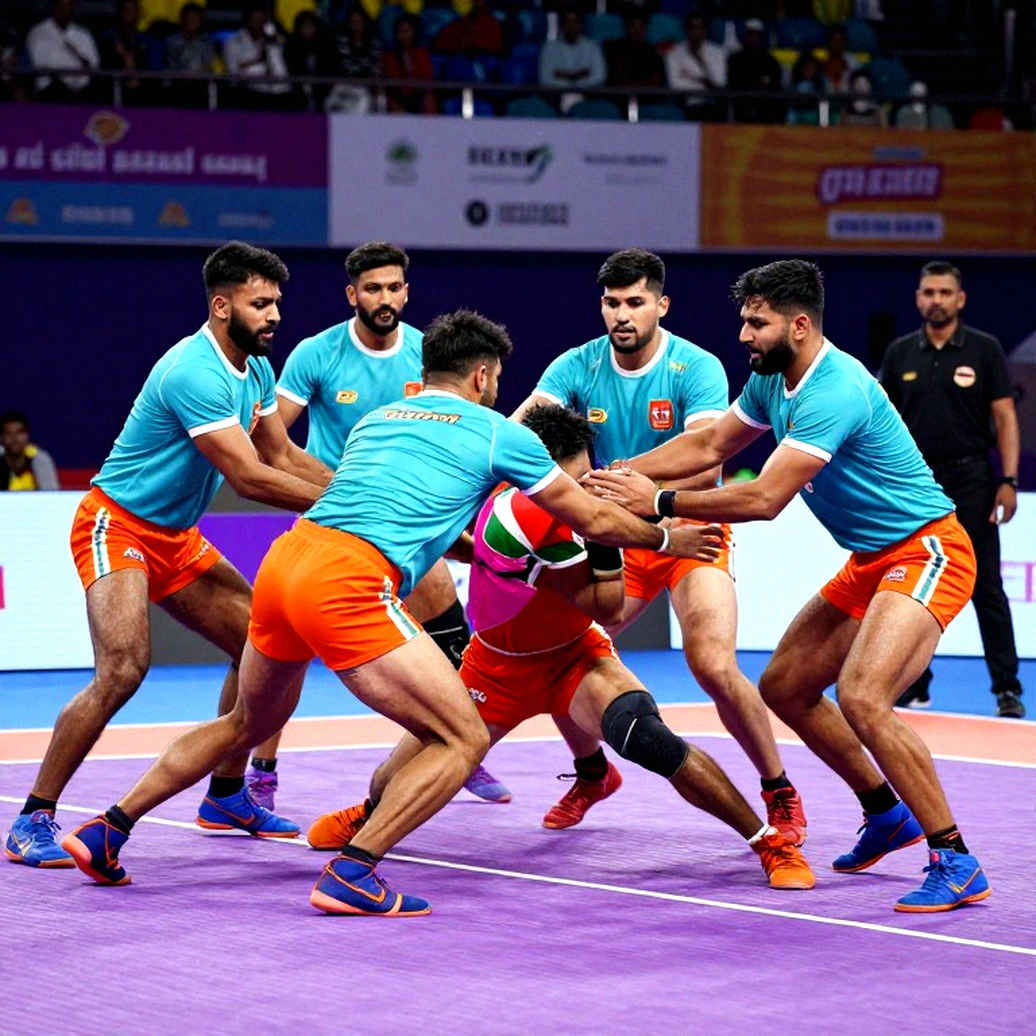
The first thing you notice at the training ground is who arrives before the lights. In Ahmedabad this is a mat rather than a field, and the mat is the marker of the game that the 2026 league rewrote. But the tape that measures the mat's lines is the same tape that decides who can play and who cannot.
This is the first Commonwealth Kabaddi Championship, running from 23 to 31 October over nine days: 23 teams from 13 nations, 62 matches in all, 39 men's and 23 women's. The Amateur Kabaddi Federation of India is organising it with approval from the International Kabaddi Federation, in the city preparing to host the 2030 Commonwealth Games. That last clause is the most important sentence in the release and the least read.
Start with the arithmetic nobody puts in the press note. The men's Group A has seven teams — India, Nigeria, Malaysia, Uganda, England, Tanzania and Sri Lanka — and a full round-robin of seven gives twenty-one matches. Group B has six — Bangladesh, Kenya, Canada, Australia, Scotland and Singapore — which gives fifteen. Thirty-six, plus two semifinals and a final, makes the stated thirty-nine. The women's draw has two groups of five, ten and ten, twenty matches; two semifinals and a final make twenty-three. Both draws are complete single round-robins. No wildcards, no cross-group seeding, no route that gets easier by luck of the draw. India knows in advance which day it plays whom, which day it rests, and which group its semifinal opponent will come from. That is comfort, and it is also a burden: 'the draw was unkind' is no longer available as an explanation.
Surjeet Singh captains the men's side, with Naveen Kumar as vice-captain. The fourteen-member squad also includes Sachin Tanwar, Pankaj Mohite, Bharat Hooda, Shubham Shinde and Parvesh Bhainswal. India's sequence runs England on 23 October, Uganda on 24, Malaysia on 25, Nigeria on 26, Tanzania on 27 and Sri Lanka on 29, with 28 October left blank — six matches in seven days, one rest.
Nidhi Sharma leads the women, with Ritu as vice-captain. Muskan Sharma, Riya Kumari, Simran Kamboj and Karthika Ramesh are also in the squad. Group A holds India, Singapore, Nigeria, Uganda and Malaysia; Group B has Bangladesh, Kenya, England, Scotland and Sri Lanka. India play Malaysia on 23 October, Singapore on 24, Uganda on 25 and Nigeria on 26, and then wait three days for the semifinals on 30 October.
Here the first real observation arrives, and it lives in the calendar rather than on the mat. The men play six matches in seven days; the women play four in four. The women's four group games come on consecutive days, which means almost no room to rotate. Injury, fatigue or a dip in form on day four lands directly on the result. The men get 28 October as a whole day — a day for fresh strapping, ice baths and a sit-down about raiding patterns. The women do not have that luxury.
And then the part nobody flags: semifinals on 30 October and the finals on 31, which means both finalists play on consecutive days. The two most decisive days of a nine-day tournament have been placed in a single breath. In kabaddi a night's difference matters more than any tactic when your corner is carrying nine matches of fatigue onto the mat. Whoever lifts the trophy on 31 October will owe part of that win to the sleep of the night before.
Now the shape of the squad. India's men have obvious raiding depth — Sachin Tanwar, Pankaj Mohite, Bharat Hooda, and Naveen Kumar as deputy. That combination belongs to the kabaddi the post-2026 league built: quick running hand-touches, raiding from the bonus line, raiders who do not lose their rhythm even in a do-or-die. In defence there are names like Shubham Shinde and Parvesh Bhainswal, men who have proved themselves at league pace.
One column in my notebook has never appeared in a newspaper: tackle attempts per defender. At the 2026 Senior Nationals I was the only woman in the press enclosure, and a Railways coach waved away my question about left-cover positioning by saying they should send someone who understood raiding. I started counting that number myself that evening, because nobody published it and I needed proof I had been watching. It is still the first thing I look for in a squad sheet — who is at left cover, and whether the man beside him listens to him.
Kabaddi at a multi-sport event runs on different laws from league kabaddi. In the league the raiding argument wins; at Asian Games and World Cups, defence decides results. The most expensive proof is the 2026 Jakarta semifinal, where India lost 18-27 to Iran and had to settle for bronze. That defeat did not belong to one raider. It belonged to selection on reputation against a defensive system built on a wrestling base. The seven-title run ended that day; gold returned in 2026 and 2026, but the lesson held — on the mat, defence comes first.
India's semifinal opponent will be one of the top two from Group B, and the likeliest name is Bangladesh, a country that has stood in the Asian Games medal table and whose standard-style experience is not far behind India's. Sri Lanka can do what Sri Lanka always does: slow the game, lengthen the raids, question your patience. Nigeria is Africa's most organised kabaddi system and the easiest side in the draw to underestimate.
This is the fault line I call the two kabaddis. Most of the sides arriving from England, Scotland, Canada and Australia come out of the circle tradition that travelled from Punjab to Britain, Canada and Australia — kabaddi played on mud, in an open circle, with long breath and no clock. Here they meet a thirty-second raid clock, a bonus line, and corners who are athletes at twenty.
So Friday's match against England looks one-sided on paper and is in fact the most interesting fixture of the day, because it is a chance to watch how quickly a circle-tradition side adapts to standard-style discipline. Inside that adaptation sits the question every kabaddi administrator asks: can this sport grow outside the subcontinent? If the answer is yes, it will be decided by whether a team can change its raiding rhythm in three days, not by how many years a country has played the game.
Which is also the right way to read the day-one ledger. India's raid-success rate against England tells you nothing; every raider looks good against weak defence. I will watch three things in that match: how many of India's raids were allowed to reach do-or-die, how many tackle attempts the left cover made, and how early the substitutions came. The third matters most — if the team tests its bench in the very first match, both captain and coach already know the real examination begins after the 28th.
Now the thing not in the tournament's publicity. Twenty-three teams from thirteen nations is a good-looking number. It is a map of the Commonwealth, not a map of kabaddi strength. Iran is not in this field. Nor is South Korea, Thailand, Japan or Chinese Taipei. Iran is the team that beat India in a Jakarta semifinal; the league's all-time tackle-points record belongs to an Iranian. Commonwealth membership means those teams cannot be here — that is not the tournament's fault, it is its architecture.
One detail still catches the eye: Pakistan and Nepal are absent, though both are Commonwealth members with active kabaddi systems. Those two missing names make the thirteen-nation figure a little lighter. I am not claiming to know why. I am saying that a tournament billed as the first Commonwealth championship should be asked the question and should answer it.
None of which means the tournament does not matter. It means its real test is off the mat. Getting through 62 matches in nine days means putting in one place, for the first time, everything a multi-sport event demands — weigh-ins, dope control, accreditation, broadcast windows, mat-changeover time, official rosters. That is the genuine rehearsal for what Ahmedabad has been promised in 2030. Whether kabaddi gets a place at the Commonwealth Games will not be decided by one final's score; it will be decided by whether a host can demonstrate it can run this sport for nine days without a hitch.
Let me state a habit plainly, because it decides the direction of my pen. Whenever a big tournament begins, I first work out whose name will be said first if it goes wrong. It will happen here too. If India lose the semifinal on 30 October, three names will fall first: captain Surjeet Singh, vice-captain Naveen Kumar, and whichever raider's last raid is remembered. My notebook will record something else: by the 27th that team had played five matches, rested on the 28th, played its last group game on the 29th and a semifinal on the 30th. Expecting any player to produce his best twice in twenty-four hours is a question about a calendar, not about character. When the room looks for someone to blame, I look for the person who arrived early — and the calendar always arrives first.
The same applies twice over to the women. India's women have four Asian Games golds and no franchise league. That is an inverted structure: the medals exist, the money may or may not follow. Their four group matches fall on four consecutive days, followed by a three-day gap to the semifinal. Their real examination is not the group stage but 30 October, and the road there runs through fatigue that no broadcast graphic will show.
If anyone asks which fixture in these nine days deserves the closest watch, my answer is not England. It is 29 October — India's last group match, against Sri Lanka, twenty-four hours before the semifinal. On that day the team must decide how much to stake. Full strength may buy a better draw or a heavier next morning; the bench is safer but can break rhythm. That is the moment a team's internal relationships show themselves honestly, and from outside it looks like one more win on a scoresheet.
I acquired the habit of arriving three days early at the 2026 World Cup in Panvel. I got there before the accreditation desk opened and simply sat through India's camp sessions. Nobody else did. The final result went out on the wires within minutes; what I had was the rhythm of the third day of training and one defender's ankle-strapping routine. I do not have those three days in Ahmedabad this time. What I do have is knowing where to look.
So my expectations rest on three things, all visible from the edge of the mat. First, whether the men's team settles its left-cover pairing in the first three matches or keeps changing it — a change would mean the staff is already pricing in knockout fatigue. Second, how much of the bench the women use on day four against Nigeria; three technical changes there would tell you the coach has started building for 30 October. Third, and hardest — how many of those 62 matches are still alive in the last five minutes. That is the number that will say whether this thirteen-nation field is deep, or merely wide.
When the final whistle goes on the evening of 31 October, no scoreboard will carry a line about what this tournament adds to the 2030 file. That accounting starts the next morning in a different notebook, and its first question will be whether a Commonwealth Games kabaddi mat will ever have room for a team like Iran — or whether we will keep admiring ourselves in our own reflection.