
Pakistan Beat Hong Kong in Hong Kong Sixes Plate Semi-final, Set Up Oman Final
हांगकांग सिक्सेज के प्लेट सेमीफाइनल में पाकिस्तान ने हांगकांग को हराया। हांगकांग ने छह ओवर में तीन विकेट पर 106 रन बनाए (निजाकत खान 38, अन्शी रथ 37)। पाकिस्तान ने 4.3 ओवर में पांच विकेट पर 107 रन बनाकर लक्ष्य हासिल किया। अब्बास अफरीदी ने 13 गेंदों पर 55 रन (3 चौके, 7 छक्के) बनाए, खवाजा नफ़ाय ने 10 गेंदों पर 34 रन। पाकिस्तान अब प्लेट फाइनल में ओमान से भिड़ेगा। छह बार का चैंपियन पाकिस्तान ग्रुप में यूएई से आखिरी गेंद पर हारने के कारण मुख्य कप से बाहर हुआ।
Pakistan beat hosts Hong Kong in the Plate semi-final of the Hong Kong Sixes on Saturday to book a place in the Plate final. Hong Kong, batting first, made 106 for 3 in their allotted six overs. Pakistan chased it down in 4.3 overs, finishing on 107 for 5. Abbas Afridi produced a stunning 55 off just 13 balls, including three fours and seven sixes. Khawaja Nafay made 34 off 10, while Abdul Samad added 17 off four. For Hong Kong, Nizakat Khan made 38 off 10 and Anshy Rath 37 off 15. Pakistan will now face Oman in the Plate final.
On the surface this is a routine semi-final result. In context it is the most talked-about story of the tournament. Pakistan are six-time champions and the defending title holders. That a team of that pedigree is playing a Plate semi-final, meaning it has been knocked out of the main Cup into the consolation bracket, is a story in itself. This match is part of that story, which is why a straight scorecard alone does not tell it.
Hong Kong's innings: short, sharp, substantial
Hong Kong chose to bat first in a six-over format, which is the percentage call. Their innings had a distinct shape: 106 for 3, roughly 17.6 runs an over. In six-over cricket that is a strong score, though not a decisive one.
The innings was built on two knocks. Nizakat Khan made 38 off 10 balls with one four and five sixes. Of those 38 runs, 34 came over the rope; four were run. From a strike-rate perspective that is an extraordinary return — he cleared the boundary roughly every other ball. In a six-over game, an innings like that destroys the opposition's bowling plan, because whether the fielders are on the rope or in, the ball is going into the crowd.
Anshy Rath made 37 off 15, with four fours and three sixes. Thirty-four of his runs came in boundaries and three by running. It was a slower knock than Nizakat's, but calling it slow would be unfair. Its main function was to hold one end so that Nizakat could play with freedom. In a six-over format, a batter facing 15 balls is effectively shielding one end for nearly half the innings. When someone plays that role, the other end becomes an explosion.
Nasrulla Rana made 16 off three balls with one four and two sixes — all 16 runs in boundaries. A line like that can be dismissed as a footnote, but in reality it decided the closing phase. In the last overs, a boundary is needed off almost every ball, and 16 off three means he accelerated without wasting a delivery.
Babar Hayat made 12 off six with three fours, all 12 in boundaries. Yasim Murtaza was dismissed without scoring.
A small arithmetic gap
Added together, those named batters account for 103 runs off 34 balls. The team score is 106 for 3 off 36 balls. That leaves three runs as extras and two balls faced by a batter not named in this report. This is not a contradiction; it is the normal residue of any scorecard. As long as the total and the ball count reconcile, the card is internally consistent.
Run rate alone, though, does not capture how well Hong Kong's top three batted. Between them they made 91 off 28 balls, all at strike rates above 200. In six-over cricket, that is the kind of batting that forces the opposition captain to change fields from the first over.
Pakistan's bowling: few balls, large impact
Pakistan's bowling figures show something odd but entirely natural to this format. Irfan Khan took two wickets in two balls; Ahmed Daniyal took one in one. Three wickets fell in three deliveries.
In six-over cricket every bowler bowls a maximum of six balls and every batter is forced to attack, so the probability of a wicket per ball is far higher than in longer formats. A bowler who takes two in two sees his entire spell compressed into a two-ball line, which looks absurd from outside but is simply the format at work.
Taking two wickets in two balls usually signals a yorker or a batter forced into a mistake. It does not mean Pakistan bowled brilliantly. Conceding 106 in six overs means Hong Kong's batters won most of the exchanges. But those three wickets must have come at the moment Hong Kong were trying to push from the 130-140 range, and stopping that acceleration proved the difference.
Note the asymmetry: only Pakistan's bowlers are listed. There is no record of who took wickets for Hong Kong. That imbalance is itself a signal about the perspective of the source report — it is built around Pakistan's performance and silent on the hosts' bowling.
Pakistan's chase: 27 balls of fury
A target of 107 in six overs is not large, but it is not trivial either; it demands roughly 18 an over. Pakistan got there in 4.3 overs, i.e. 27 balls, with nine balls to spare. In a six-over game, nine balls in hand is a wide margin. It is the kind of margin that builds confidence going into a final.
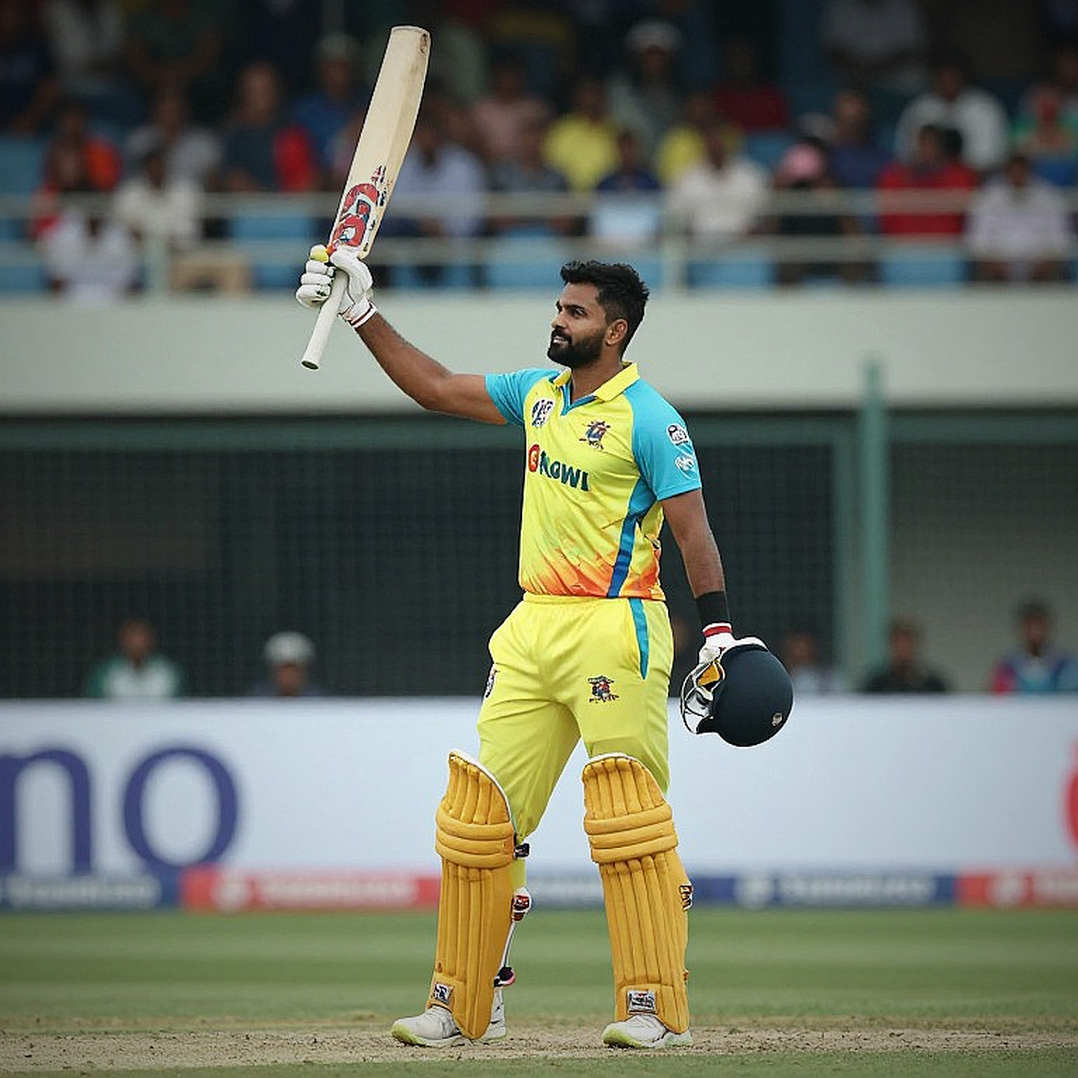
Abbas Afridi's innings was the spine of the chase: 55 off 13 balls, three fours and seven sixes. Fifty-four of those runs came in boundaries and one by running. In one sentence: he cleared the rope roughly every other ball. In a format where no batter has time to build an innings, 55 off 13 means he effectively annexed the chase.
Khawaja Nafay made 34 off 10 with two fours and four sixes — 32 in boundaries, two run. This is the role that gets overlooked: when one end is going at above 200, the other end must hold and keep the tempo. Nafay did exactly that, and did not lose momentum when Afridi retired.
Abdul Samad made 17 off four with one four and two sixes — 16 in boundaries, one run. Small, but far from inconsequential: when the bowling was applying pressure in the middle overs, 17 off four kept the required rate intact.
The three batters account for 106 runs off 27 balls; the team score is 107 for 5, i.e. one extra. Arithmetically this closes perfectly, since 27 balls is exactly 4.3 overs.
The five-wicket puzzle
Here is a point every reader should know and every editor should flag. Pakistan lost five wickets. If three batters faced all 27 balls, the remaining batters must have been dismissed without facing a delivery — run out at the non-striker's end, or otherwise. In a six-a-side team, three consecutive batters being dismissed without facing a ball is technically possible but highly unusual.
The more plausible alternative is that a retirement was counted as a wicket, or that some batters' figures were omitted from the report. The report explicitly mentions Afridi's retirement after reaching 55. If retirement was counted as a wicket, the true wicket count is four and the five is misleading.
So when citing this match, use the score 107 for 5 in 4.3 overs, because that is the official score. But do not draw the further conclusion that "three batters faced every ball and five wickets fell", because the two statements cannot both be exactly true.
A coincidence worth flagging
The report states that in Pakistan's group match against the UAE, the UAE also made 106 for 3 in six overs, with a target of 107. The scorecard of this semi-final against Hong Kong is therefore near-identical to that match.
In six-over cricket, 106-107 is unremarkable; it is a score that emerges from good batting plus a few extras. But two different matches producing an identical total, identical wickets and an identical target is the kind of coincidence that may also be an editorial copy error. There is no independent verification available, so it should be logged as a coincidence, not as fact.
Why is the champion team in the Plate?
This is where the match report ends and the story begins. Pakistan are six-time champions and defending winners. The team widely regarded as the Cup favourite is playing in the Plate bracket.
The cause was one defeat and one win in the group stage. First, Pakistan lost their opening match to the UAE off the final ball. That is the most expensive kind of defeat in any tournament, because you spend the rest of the event dependent on other results.
Pakistan then beat their traditional rivals India, described in the report as a convincing victory. That win kept them alive and provided the base for reaching the Plate semi-final.
But the group's fate lay with the UAE. When the UAE beat India, they took top spot and closed Pakistan's route into the Cup. In other words, Pakistan had already surrendered control of their fate on day one and were thereafter dependent on results elsewhere.
Under the tournament's format, the group winner goes straight into the Cup, the second-placed team plays in the Plate and the third-placed team drops to the Bowl. It is a format in which a single defeat can push you down a tier regardless of how well you play otherwise.
Format or performance?
The report says a narrow opening-match defeat "proved costly under the tournament's format". That sentence sounds neutral but carries an interpretation: it attributes Pakistan's failure to the format rather than to their ability.
The interpretation is not wrong. The format is genuinely punitive. But it is not the whole story. Losing off the final ball is itself a performance issue: had the team made 20-25 more runs, or taken one more wicket, the format would have been survivable. The line between "the format's fault" and "the team's fault" is not clean.
For readers it matters which part is fact and which is interpretation. The facts: Pakistan lost the opener, the UAE won off the final ball, the UAE beat India, the UAE finished top, Pakistan finished second and therefore played in the Plate. The interpretation: the format was the main cause. The report blends the two without separating them.
Hong Kong's side: an honest assessment
Hong Kong did what was expected of them. They made 106 for 3 and their innings never visibly collapsed.
Nizakat's 38 was tiny in balls and large in impact: five sixes in ten deliveries means a boundary in almost every over. Rath's 37 off 15 gave the innings ballast. Hayat and Rana added late acceleration. Overall it was a well-constructed innings.
The shortfall was in how and when wickets fell. In six-over cricket, every wicket means a new batter who needs a few balls to find tempo. Losing three wickets en route to 106 suggests they never preserved wickets for a bigger total; one fewer wicket might have meant 120-odd.
The report gives no detail on Hong Kong's bowling. That is a significant gap, because Hong Kong's bowlers contributed to that 107 and it matters where the plan broke down. Was Afridi allowed to hit with the short boundary? Was a catch dropped? The available information does not answer these questions.
The delivery that decided it
The report contains no account of a moment or a ball that turned the match. It states what happened, not how. That is its biggest narrative weakness.
Some inferences are possible from the numbers. Pakistan reached 107 in 4.3 overs, 27 balls. Had they needed 36, the match would have gone to the last ball and the pressure would have been on them, which is Hong Kong's opportunity. Afridi's 55 off 13 removed that possibility. When a batter makes 55 off 13, the opposing captain has no answer: he can change fielders and bowlers, but if the batter is in that frame of mind, those changes have limited effect.
The final against Oman: what we know and do not know
Pakistan face Oman in the Plate final. Oman won the other semi-final, but the report does not say whom they beat or how. Nor does it state when or where the final will be played.
This is a serious gap. A story announcing that a team has reached a final should also tell readers when to watch it. Beyond that, without knowing Oman's line-up, their key batters and their attacking bowlers, a preview is meaningless.
What can be said about the final is this: it is Pakistan's chance to end the tournament with silverware, even if not the main Cup. The Plate is a consolation trophy, but for a six-time champion it beats going home empty-handed. In cricket every trophy has a value, and winning momentum matters to any side.
Six-time champions: the real face of the tournament
The Hong Kong Sixes is a small tournament with a large history. Pakistan have won it six times. That figure explains how Pakistan's cricket DNA fits six-a-side: this format demands courage in batting, and Pakistani cricketers have traditionally been known for exactly that.
But history is also a burden. When you have won six times, every defeat becomes a question. When you are the defending winner, reaching the Plate is the same as exiting the Cup. That is why this match is a big story despite being an ordinary semi-final win.
And this is where the report drifts from its headline. The headline says: Pakistan won and reached the final. But much of the text is answering why the champion team is in the Plate. It is a hybrid of match report and explanatory retrospective, and the balance is off — the background section is longer than the match itself.
What the scorecard actually tells us
Three things are clear.
First, in six-over cricket, 106 is not safe. Hong Kong made 106 for 3 with two batters striking above 200 and still lost. In this format no total is safe, and the psychological pressure of a target is far greater.
Second, 55 off 13 shows that one individual can decide a game in under 20 balls. That is part of what makes the format popular, and also part of what makes it unreliable as a predictor of form.
Third, Pakistan again showed that they become extremely aggressive when chasing a small target: 107 in 4.3 overs is roughly 23 an over. That is a tempo that defeats a captain's planning, because when every ball is going to the boundary, no field setting works.
Does Hong Kong get short-changed?
Hong Kong are the hosts. Yet the report never says how they reached the Plate semi-final, what their group record was, or whom they beat. That is a notable gap, because readers want to know how the home team's campaign went.
The available numbers show Hong Kong made mistakes in this match but not where or why. Without details of Hong Kong's bowling, without a single mention of fielding, and without a word from a coach or captain, the picture of this match remains incomplete.
How much can this report be trusted?
There is no byline, no agency tag and no time reference beyond the dateline. It reads as a match report but never says where the information came from.
The data is granular: runs, balls, fours and sixes for each batter. That suggests official scorecard or stadium input. The internal arithmetic almost reconciles. But the five-wicket question, the duplicated 106 for 3 across two matches, and the rule ambiguity around retirement are three points that require caution.
So read it this way: scores and figures are dependable; the account of the match is derived from those figures; and the "why" sections contain interpretation, which should be read as analysis rather than fact.
Where Pakistan stand before the final
Reaching the Plate final means Pakistan have made the most of what this tournament offered them. But it is also true that winning the Plate would not let them call the campaign a success. Against expectations, for a six-time champion, a Plate title is still a consolation prize.
Still, psychology matters in cricket. Win the Plate and the team has a trophy and some momentum for the next edition. Lose and the tournament ends empty-handed. The difference is both small and large.
Little is known about Oman, so no meaningful preview is possible. One thing can be said: against a side that has just made 107 in 4.3 overs, every bowling attack comes under pressure.
Conclusion
This match tells a clean story: Pakistan chased aggressively, Hong Kong made a respectable 106 and could not defend it, and Pakistan reached the Plate final. At the level of numbers the report is clear.
But the match is also part of a bigger story the report never properly tells: how a six-time champion and defending winner fell out of the main Cup. One defeat, off the final ball, changed the route of the entire tournament. That is both the beauty and the cruelty of the game.
Three things are worth remembering. First, the primary facts are 107 for 5 in 4.3 overs and 106 for 3 in six overs. Second, Afridi's 55 off 13 was the decisive passage of play. Third, and most importantly, Pakistan meet Oman in the final, and any side will be a handful there, because in six-over cricket the team batting first is never easy to overhaul.