
Commonwealth Kabaddi Championship 2026: India's Real Test Isn't England, It's the Three African Sides
**मुख्य उत्तर:** कॉमनवेल्थ कबड्डी चैंपियनशिप का पहला संस्करण 23 से 31 अक्टूबर 2026 तक अहमदाबाद के वीर सावरकर स्पोर्ट्स कॉम्प्लेक्स में होगा। 13 देशों की 23 टीमें नौ दिनों में 62 मैच खेलेंगी। भारतीय पुरुष टीम 23 अक्टूबर रात 8:30 बजे इंग्लैंड से और महिला टीम उसी दिन शाम 6:45 बजे मलेशिया से भिड़ेगी। **मुख्य तथ्य:** - आयोजन 23–31 अक्टूबर 2026, वीर सावरकर स्पोर्ट्स कॉम्प्लेक्स, अहमदाबाद; कुल 62 मैच — 39 पुरुष, 23 महिला। - 13 देशों की 23 टीमें; इनमें से 10 देशों ने पुरुष और महिला दोनों टीमें भेजी हैं। - पुरुष कप्तान सुरजीत सिंह, उपकप्तान नवीन कुमार; महिला कप्तान निधि शर्मा, उपकप्तान रीतू। - सेमीफाइनल 30 अक्टूबर, दोनों फाइनल 31 अक्टूबर; आयोजक AKFI, अनुमोदन IKF का। - पहला मैच 23 अक्टूबर सुबह 11:00 बजे, पुरुष ग्रुप B में केन्या बनाम सिंगापुर। **स्रोत:** आधिकारिक टूर्नामेंट विज्ञप्ति एवं प्रकाशित रिपोर्ट, प्रकाशन तिथि 22 अक्टूबर 2026। **संबंधित प्रश्न-उत्तर:** प्रश्न: भारत का पहला मुकाबला किससे और कब है? उत्तर: पुरुष टीम 23 अक्टूबर 2026 को रात 8:30 बजे इंग्लैंड से और महिला टीम उसी दिन शाम 6:45 बजे मलेशिया से खेलेगी। प्रश्न: टूर्नामेंट में कुल कितने मैच होंगे? उत्तर: नौ दिनों में कुल 62 मैच — 39 पुरुष वर्ग में और 23 महिला वर्ग में। प्रश्न: क्या ईरान और दक्षिण कोरिया इस चैंपियनशिप में खेल रहे हैं? उत्तर: नहीं, ये कबड्डी की प्रमुख एशियाई ताकतें कॉमनवेल्थ सदस्य देश न होने के कारण इस 13 देशों वाली फील्ड में शामिल नहीं हैं।
If India's men reach the final in Ahmedabad on the night of October 31, they will have played eight matches in nine days — six group games, a semi-final and a final. There is exactly one rest day in between, October 28. That day is not a gift; it is the residue of squeezing five of India's six group matches into five consecutive dates, which left the calendar with no choice but to go blank on the 28th.
Across every kabaddi preview I have read in recent years, one thing goes missing: the match count and what it does to a body. The previews carry the captain's name, the trophy expectation and a sentence about Indian dominance. Nobody shows the calendar. Yet an eight-in-nine schedule decides who India's third raider is, when the fourth defender gets on the mat, and what condition the team is in when the semi-final arrives.
The number nobody quotes is the one that explains the whole tournament — and this time it isn't 62, or 13, or the 39-23 split. It is eight-over-nine. Nine days, eight matches, one rest day. The biggest player on the Veer Savarkar Sports Complex mat from October 23 onward is not a raider. It is the recovery window.
Context: a first edition inside a 106-year-old frame
The inaugural Commonwealth Kabaddi Championship runs from October 23 to 31, 2026, in Ahmedabad, organised by the Amateur Kabaddi Federation of India (AKFI) with approval from the International Kabaddi Federation (IKF). Twenty-three teams from 13 nations will play 62 matches across nine days — 39 in the men's competition, 23 in the women's.
The first match is at 11:00 AM on October 23: Kenya against Singapore in men's Group B. Both Indian teams play that evening. The women, captained by Nidhi Sharma, face Malaysia at 6:45 PM. The men, captained by Surjeet Singh, meet England at 8:30 PM. That sequencing is itself a statement — the host's women play first, the men later. On paper it reads as parity. In practice it is a prime-time decision, and prime-time always goes to the side that sells the tickets.
Men's competition: 13 teams, two groups. Group A has India, Nigeria, Malaysia, Uganda, England, Tanzania and Sri Lanka — seven teams. Group B has Bangladesh, Kenya, Canada, Australia, Scotland and Singapore — six. A seven-team group means six matches per side; a six-team group means five. India's six group fixtures run October 23 (England), 24 (Uganda), 25 (Malaysia), 26 (Nigeria), 27 (Tanzania) and 29 (Sri Lanka).
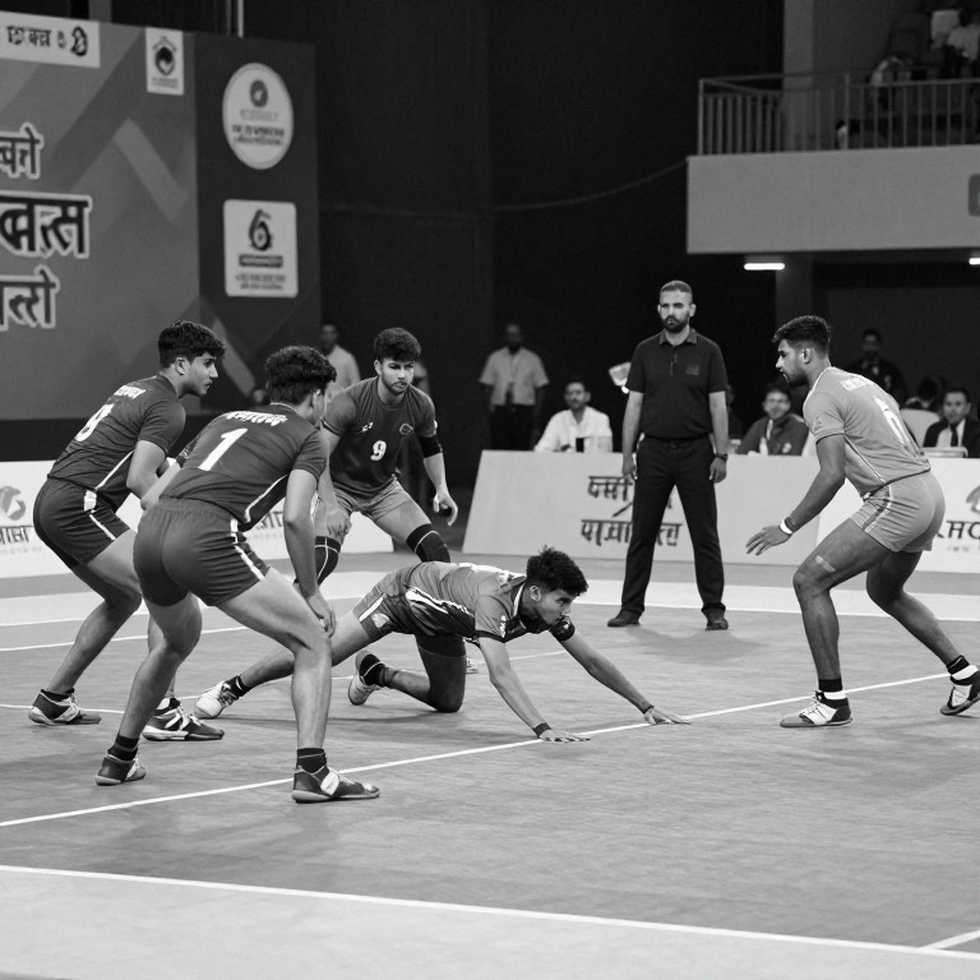
Women's competition: 10 teams, two groups of five. Group A has India, Singapore, Nigeria, Uganda and Malaysia. Group B has Bangladesh, Kenya, England, Scotland and Sri Lanka. India's women play Malaysia on October 23, Singapore on 24, Uganda on 25 and Nigeria on 26. Semi-finals are on October 30; both finals on October 31.
India's 14-member men's squad includes vice-captain Naveen Kumar, Sachin Tanwar, Pankaj Mohite, Bharat Hooda, Shubham Shinde and Parvesh Bhainswal. Ritu is the women's vice-captain, alongside Muskan Sharma, Riya Kumari, Simran Kamboj and Karthika Ramesh.
And one line appears in every organiser release: this tournament sits inside Ahmedabad's build-up to hosting the 2030 Commonwealth Games. That single sentence turns a sporting event into a document, and the nine days have to be read through that lens.
The arithmetic nobody printed
The group-stage maths is simple, which is probably why it gets skipped. Seven men's teams in Group A means 21 matches; six in Group B means 15. That is 36. Two women's groups of five produce 10 matches each, so 20. Four semi-finals and two finals add six. Total: 62.
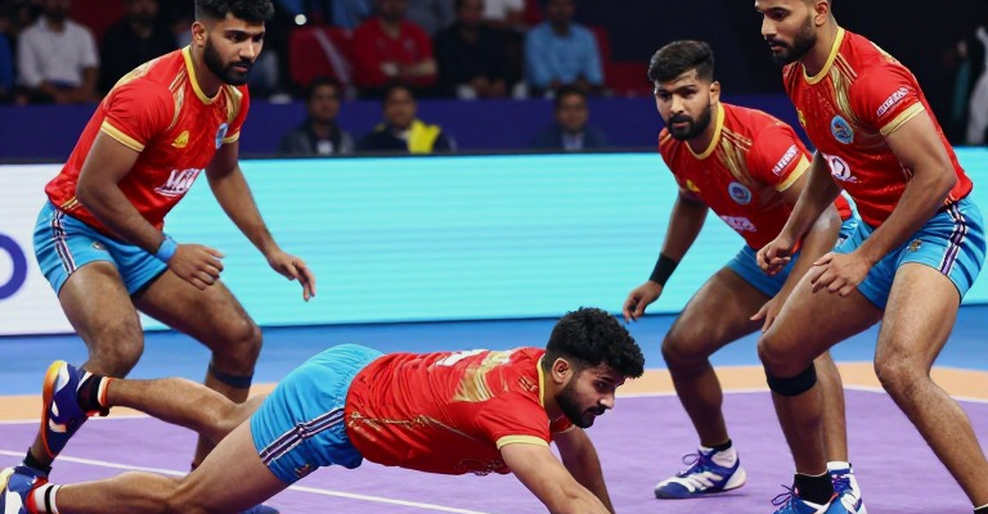
This matters because 56 of those 62 matches are group games that must be cleared in roughly seven days — about eight matches a day. Eight matches a day cannot happen on one mat. Which means at least two mats running simultaneously in Ahmedabad, two refereeing panels, two scoring desks, two video setups, and at least one evening when India is playing while another match is live on the adjacent mat.
That is where the tournament's real examination begins, and it is an operational exam, not a kabaddi one. When I wrote fourteen posts about Patna's three-peat in 2026, I believed kabaddi's biggest weakness was data. I now think it is the day six matches run at once and nobody can say which raider came in at which minute on the second mat.
For India the maths bites twice. Six group matches in seven days, and if they go all the way, eight in nine. A 14-man squad is seven starters and seven rotations. Rotating in kabaddi is not like football — a raider needs rhythm, a corner needs timing, a cover needs two raids just to read the opposing raider's habits. If you make three changes every match across five straight days, you are re-wiring three partnerships every match.
India's real selection problem is not who starts. It is when the eighth, ninth and tenth players get minutes, because the choice made between October 24 and 25 will decide how light the team's legs feel on October 30.
The teams that aren't here are the story
The Commonwealth has 56 members. Thirteen turned up. That is 23 per cent, and it is proof the field was picked by geography rather than by kabaddi strength.
Picking by geography has a clear consequence: four of the world's strongest kabaddi nations are missing. No Iran, no South Korea, no Chinese Taipei, no Thailand. No Pakistan either. The men's field is without all four sides that have genuinely troubled India since Jakarta 2026, and the women's field is without the sides that made India sweat through four Asian Games golds.
That reads like a criticism. My intent is the opposite. The Commonwealth Games charter requires regional spread from every sport — Africa, Asia, Europe, the Americas and Oceania all represented. Look at the thirteen: India, Malaysia, Singapore, Sri Lanka, Bangladesh (Asia); Kenya, Nigeria, Uganda, Tanzania (Africa); England, Scotland (Europe); Canada (Americas); Australia (Oceania). All five regions are present. The field isn't weak. The field is a map. That distinction has gone unwritten.
Now the number nobody quotes, the one that explains the whole thing: ten of the thirteen nations have brought both a men's and a women's team. Only three — Tanzania, Canada and Australia — sent men only. That is 77 per cent gender participation, unusually high for a first edition of any Commonwealth sport. For a sport asking for a place at the 2030 Games, that figure is a stronger argument than the 62-match count.
The picture has a crack, though, and it shows in the match split. Thirty-nine men's matches against 23 women's. Thirty-seven per cent of the programme. Per team the gap widens: a men's Group A side plays six, a Group B side five, a women's side four. The Indian spectator buying a ticket will see the men six times and the women four. Gender parity has been declared in the list of participants, not on the match sheet.
The African tackle: the 2026 lesson nobody is watching
Count India's group opponents again: Nigeria, Malaysia, Uganda, England, Tanzania, Sri Lanka. Three of the six are African. India will play three of six group matches against sides whose sporting culture comes out of wrestling.
I watched India lose that 18-27 semi-final in Jakarta in August 2026, after the 23-24 group defeat to South Korea. Every column called it a betrayal of heritage. I wrote 900 words then under the headline Physics, Not Betrayal. My argument was simple: Iran had converted wrestling hips, ankle control and low-body balance into tackles, while India had selected on reputation. It looks like betrayal until you draw the free-body diagram.
Draw that same diagram over Africa. Nigeria is one of the continent's great wrestling nations; its name sits in Commonwealth wrestling medal tables every cycle. Uganda and Kenya build athletes through wrestling and athletics rather than through red-court rhythm. Tanzania is the least rated of the four, and Tanzania arrives on October 27 — the fifth consecutive match day, when fatigue is at its worst.
Which is the real technical question of this tournament: can an African side do what Iran did in 2026 and turn wrestling hips and ankles into kabaddi tackles? If yes, India has to learn a new defensive language before 2030. If no, this tournament's entire value is operational rehearsal.
I know how thin this claim stands. Nigeria, Uganda and Tanzania have almost no public kabaddi data — no raid-success rates, no tackle ledger, no video archive. That is why I am calling it a hypothesis, not a prediction. Hypotheses carry a price, and I pay mine below.
England: being the opener is not the same as being the threat
On October 23 at 8:30 PM, England will be across the mat, and every broadcast will call it a perfect start. I agree, for the opposite reason.
English kabaddi is built from the diaspora and the university circuit. Big bodies, good fitness, decent discipline. The gap sits where kabaddi's real craft lives: the speed of reading an opponent's habits. British sides often look organised for two raids and start leaking cover positioning by the fifth. When an Indian raider begins dropping into depth behind the bonus line on the third and fourth raid, that inexperience becomes tackle points.
Don't dismiss England, but don't hand it Iran's chair either. India's hardest group match is Nigeria on October 26; the second hardest is Uganda on October 24, simply because it is day two, with match one's recovery unfinished.
Sri Lanka belongs in that conversation and is the easiest side to overlook. Sri Lanka comes from the South Asian tradition where kabaddi is learned in school, not on a mat. Those teams are technically clean and carry no fear of losing. October 29, the last group game, one day before the semi-final, is the fixture where India must spend as little as possible — which is the hardest instruction in sport.
The women's field: four golds, four group games, an empty ledger
Under Nidhi Sharma, India's women open against Malaysia at 6:45 PM on October 23. Group A also holds Singapore, Nigeria, Uganda and Malaysia. Four matches, then a semi-final.
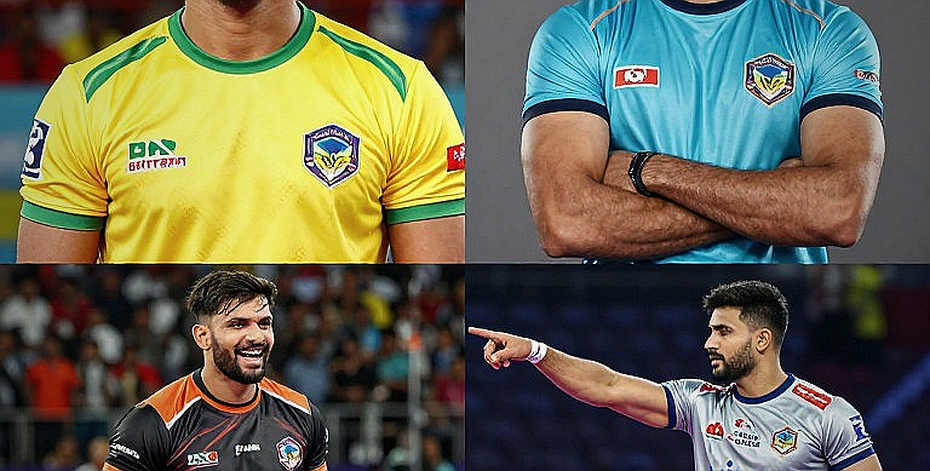
Indian women's kabaddi owns four Asian Games golds. It does not own a franchise league. I have written that sentence many times and it gets truer each time. Somewhere in the ledger a point arrives where a hiatus stops being an excuse and becomes a fact. Women's kabaddi is at that point.
Place this tournament in that ledger. Four group matches — Malaysia, Singapore, Uganda, Nigeria. None of them has a recent record of beating India. Which makes those four games practice, not competition. And that is the structural problem: the talent exists, the stage does not; and when a stage appears, the real rivals are absent from it.
Chinese Taipei, South Korea, Thailand and Iran are not here. India's women will play six matches in this tournament and not one of them will be at the level of an Asian Games final. For a sport whose entire identity rests on four golds, that is an odd reward — a medal without an exam.
Here is the weakest link in my own argument. If the real rivals are absent, is the tournament worthless for India's women? No — but the benefit isn't the medal. It is that four matches in four days let you put your fourth and fifth raiders on an international mat. India's women have had a near-static top seven for years and a bench that has never been tested. If Ritu or Muskan Sharma don't get six-plus raids across the semi-final and final, this tournament will have wasted its best opportunity.
Nine days, two mats, and a 2030 document
The part no sports page will print: this tournament is an exhibit in Ahmedabad's 2030 bid, and Commonwealth Games inclusion is not a paper exercise. Three tests apply — participation across regions, a television product that sells in 60 to 90 minutes, and both men's and women's competitions.
All three are present here. Five regions, 23 teams, two genders. What is not present is an operational track record. Sixty-two matches in nine days, about seven a day, is a heavy load for a federation. AKFI's administrative history includes suspension and an administrator-led period. That is the federation ledger, not the league ledger, and the two must be read separately. The Pro Kabaddi League's money and coverage sit with the franchises. The risk of a 62-match international event sits with the body that benefits least from it.
Practically, 23 teams across nine days means six to eight matches on some days. Two mats, two refereeing panels, two scoring systems. Kabaddi's refereeing depth is thin; finding enough international officials to carry 62 matches is harder than finding 14 players. If a do-or-die call goes wrong on a day when the video setup is busy on the other mat, the tournament's credibility starts eroding from that day.
And here is my complaint against my own profession. Sixty-two matches means seven stories a day. We will write six about India and give one paragraph to Bangladesh versus Scotland. If kabaddi wants to be a Commonwealth sport within five years, it needs coverage of Kenya versus Singapore, because those are the matches that grow IKF membership. If nobody photographed the first match of this tournament, the rest of the debate is worthless.
Where I could be wrong
I reread all fourteen of my Jakarta posts to find where I flinched. Eleven of them held up and so did the twelfth. But they shared a flaw I can see now: I built Iran's tackle-point ledger on one season of data and sold it as a two-and-a-half-year conclusion. I am on the edge of repeating that, so here is the price of my own argument.
The first thing that would prove me wrong: if India post a raid-success rate above 55 per cent across all three matches against Nigeria, Uganda and Tanzania and concede fewer than 24 tackle points combined, my African-wrestling hypothesis is dead for this cycle. In that case the whole argument becomes a 2030 hypothesis, and I would have to accept that I pasted a lesson from one 2026 tournament onto a continent without data.
Second: an African side can carry a wrestling tradition and still fail to translate it. Wrestling teaches you to grab. Kabaddi punishes the grabber who steps past the boundary, and a raider's momentum is the grabber's worst enemy. The wrestling hip I am betting on can look slow in front of a running hand-touch. Iran worked because it converted the grip into an ankle hold, not because it wrestled. If Nigeria can't make that conversion, its strength stays purely physical, and physical strength in kabaddi expires after the third raid.
Third, and swiftest: I may be over-weighting the absentees. If Iran, South Korea and Chinese Taipei never enter this circuit, the Commonwealth Championship will forever be a stage where India always wins and nobody minds. Then kabaddi's inclusion at the 2030 Games would be an easy-medal arrangement rather than an honour — and no federation can run that arrangement for more than five years, because audiences don't pay to watch inevitability.
Fourth: my absentee logic applies less cleanly to the women's draw than I have been presenting. Scotland and England's women come out of the same diaspora-university structure, but the gap is narrower than in the men's game because global depth in women's kabaddi was already thin. The women's field isn't weak; the comparison base itself is limited. I have conflated those two things before. This time I'm keeping them apart.
What to watch
Three dates, three things.
October 26, against Nigeria: watch India's corner defenders' tackle points, not the raiders'. If Nigerian raiders pull Indian corners outside the bonus line three or more times and break the chain on the fourth raid, my hypothesis survives.
October 30, semi-final: watch the third raider's raid-success rate, not the first's. The lead raider looks good in every tournament. The signal is in the third raider's volume, because an eight-in-nine schedule dumps its load on him.
October 31, final: if India lift the trophy and no date for a second Commonwealth Kabaddi Championship is announced afterwards, this wasn't a competition. It was a bid document broadcast live for nine days. If a second edition isn't scheduled within 24 months, kabaddi will have thrown away its own strongest argument for 2030.
What begins in Ahmedabad is not the biggest international kabaddi event ever staged. It is an exam, and the candidate isn't India. The candidate is the structure that packed 62 matches into nine days, pulled 13 nations from five regions, and gave the women's draw four matches per team. On the night of October 31 the scoreboard will say who won. The real result will show up in a preparatory meeting in some other city next year.