
India vs England, Match 4 of the Commonwealth Kabaddi Championship 2026: Rotation, Youth and a Hollowed-Out Field as India Begin in Ahmedabad
सारांश: कॉमनवेल्थ कबड्डी चैंपियनशिप 2026 का चौथा मैच अहमदाबाद में भारत और इंग्लैंड के बीच खेला जाएगा। यह भारत का इस टूर्नामेंट में पहला मुकाबला है। भारत ने प्रमुख खिलाड़ियों को आराम देकर कई युवा प्रतिभाओं को मौका दिया है; कप्तान सुरजीत सिंह और उपकप्तान नवीन कुमार हैं। ईरान और चीनी ताइपे इस प्रतियोगिता में शामिल नहीं हैं, इसलिए मैदान का स्तर कमजोर है और बड़े अंतर से जीत का निदान-मूल्य कम है। मुख्य प्रश्न-उत्तर: (1) मैच कब और कहां — आज रात, अहमदाबाद के शहरी खेल परिसर में। (2) कौन-सा मैच — टूर्नामेंट का चौथा मैच, भारत का पहला। (3) भारत की रणनीति — रोटेशन और युवा परीक्षण, जीत के अंतर पर नहीं बल्कि टीम-गहराई पर ध्यान। (4) इंग्लैंड का स्तर — प्रवासी समुदाय आधारित, अर्ध-पेशेवर, ईरान से काफी नीचे। (5) कबड्डी के मुख्य नियम — 30 सेकंड की रेड, लगातार 'कबड्डी' उच्चारण, बोनस लाइन, ऑल आउट पर 2 अंक, डू-ऑर-डाई, सुपर टैकल पर 2 अंक, दो हाफ 20-20 मिनट। (6) सावधानी — सार्वजनिक स्रोतों में आंकड़े अनुपस्थित हैं, खिलाड़ियों की पहचान राज्य/फ्रेंचाइज़ी संदर्भ के बिना अपुष्ट है, और 'कॉमनवेल्थ' टैग की मान्यता सत्यापन योग्य है।
Ahmedabad: India meet England tonight in Match 4 of the Commonwealth Kabaddi Championship 2026. It is India's first fixture of the tournament, and is therefore being read less as a single match and more as the opening statement of an entire campaign. What is publicly available about the fixture, however, is largely live-viewing and streaming information; the hard numbers a competitive analysis would require are almost entirely absent from the public record. The match is an international kabaddi fixture, but the information tier around it is low, and every claim should be read with that caution.
This report addresses three things: the rules under which the match will be played and how those rules shape the result; what is different about India's selection and approach; and what the competition is actually worth as a sporting test — because the field is missing its two strongest challengers.
The rules, briefly
Kabaddi is a seven-a-side sport on a 13m x 10m court in which attack and defence alternate. It can be understood as a competitive version of a traditional tag game, with wrestling-style contact layered on and a 30-second clock running over the top. The attacking player, the raider, crosses into the opponent's half, scores by touching one or more defenders, and must return to his own half for the point to count.
Throughout the raid the raider must chant 'kabaddi, kabaddi' continuously — the cant — to prove he is not holding his breath. If the chant breaks, the raid is void. This is kabaddi's defining rule: a direct check on stalling and time-wasting, and the sport's greatest source of tension.
A bonus line sits deep in the opponent's half; when the defending side has six or more players on court, crossing it earns one point — a reward for going deep. When every player on one side has been ruled out, that is an all out: the opponent gets two bonus points and the entire team is revived. This team-wipe reset makes kabaddi a sport of fast scoring and frequent swings.
After two consecutive empty raids, the third becomes do-or-die — score or be out — a rule that forces conservative teams to attack. A tackle completed with three or fewer defenders on court is a super tackle, worth two points, and is the main mechanism for short-handed comebacks.
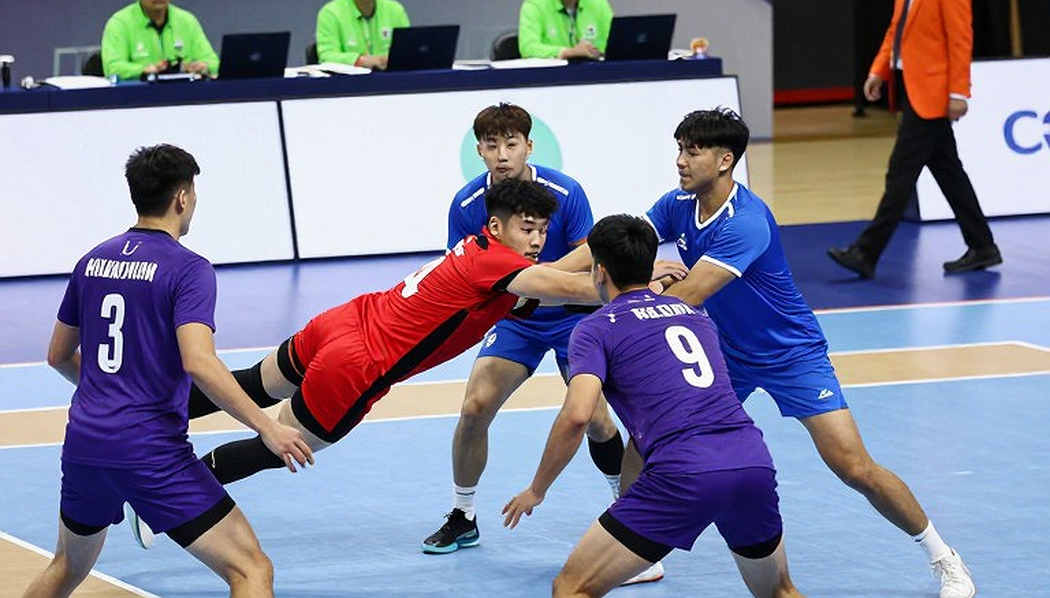
How the rules shape this match
The tournament is most likely played under standard style rules — rectangular court, two 20-minute halves, roughly 40 minutes of play — though the source material never states this explicitly, and the inference carries medium confidence. Circle style, played in rural Punjab, is irrelevant here. The source contains no rule exposition at all, which confirms it was written for readers assumed to be rules-literate.
The decisive effect is that the all out mechanism amplifies mismatches. Against a side like England, Indian raiders' touch efficiency tends to produce early all outs, which revive the opposition but also hand India two extra points each time. Scorelines in such matches therefore systematically overstate the winner's true level. The bonus line compounds this: if England fields a full seven-man defence, Indian raiders can farm single points by crossing it — technically undemanding, but severely inflating individual raid statistics. That is the key caution for anyone using this tournament's data to judge India's young squad.
The do-or-die rule limits stat-padding by stalling: even in a lopsided match the third raid must produce a point, so a young raider cannot simply burn clock. To that limited extent the data says something about individual decisiveness — but only against weak opposition. And with a 30-second round, small-sample volatility is high: one strong half can produce an eye-catching individual line that says little about season-level ability.
India: the rotation is the story
The single most consequential competitive fact is not form or scoreline but selection. India have named a different squad, resting key players and giving chances to a large group of young talents. This is a deliberate policy, and its meaning is clear: India are optimising for squad-depth discovery, not for margin of victory. The correct evaluation metric is therefore how many new caps look tournament-ready, not the final score.
The rotation is likely calendar-driven as much as developmental. With an Asian Games campaign in the same year, load management for the first-choice raiders — the squad's most injury-exposed assets — is an obvious priority.
Surjeet Singh has been named captain and Naveen Kumar vice-captain. The pairing suggests a deliberate structure: a senior spine retained while the surrounding personnel is experimental. If Surjeet Singh is the senior defender profile, his captaincy signals a defence-anchored leadership model for a young side.
A transparent caveat is required here. Both 'Surjeet Singh' and 'Naveen Kumar' are common names in Indian kabaddi, shared by multiple players across roles, and the source gives neither state nor franchise affiliation. Their exact roles and calibre therefore cannot be fixed. One plausible reading is that Naveen Kumar is the pro-league raider known as 'Naveen Express', one of the league's most efficient left-raider profiles; if so, handing the vice-captaincy to a specialist raider hints that India's designated go-to scorer is a proven league professional, with the young talents rotating around him. But that too is inference, not confirmation.
This creates a paradox. Rotation normally reduces single-point dependence; here, resting the first-choice raiders may concentrate the scoring load on the vice-captain, making this side more dependent on one raider than the full-strength team would be.
England: a damage-limitation fixture
England's men's programme is built largely on the British Punjabi diaspora and has featured at international level. Its competitive ceiling sits well below Iran's and below the Asian top tier. England's realistic objective is not a result but damage limitation and technical credibility — avoiding an early all out cascade. That is consistent with the source framing England as a curiosity rather than a threat.
The competition: a hollowed-out field
The decisive fact about this championship is the absence of Iran and Chinese Taipei, both described in the source as India's major rivals. Without them, the field's second-strongest side is materially weaker than the standard needed to test India, which makes a title here a low-information achievement.
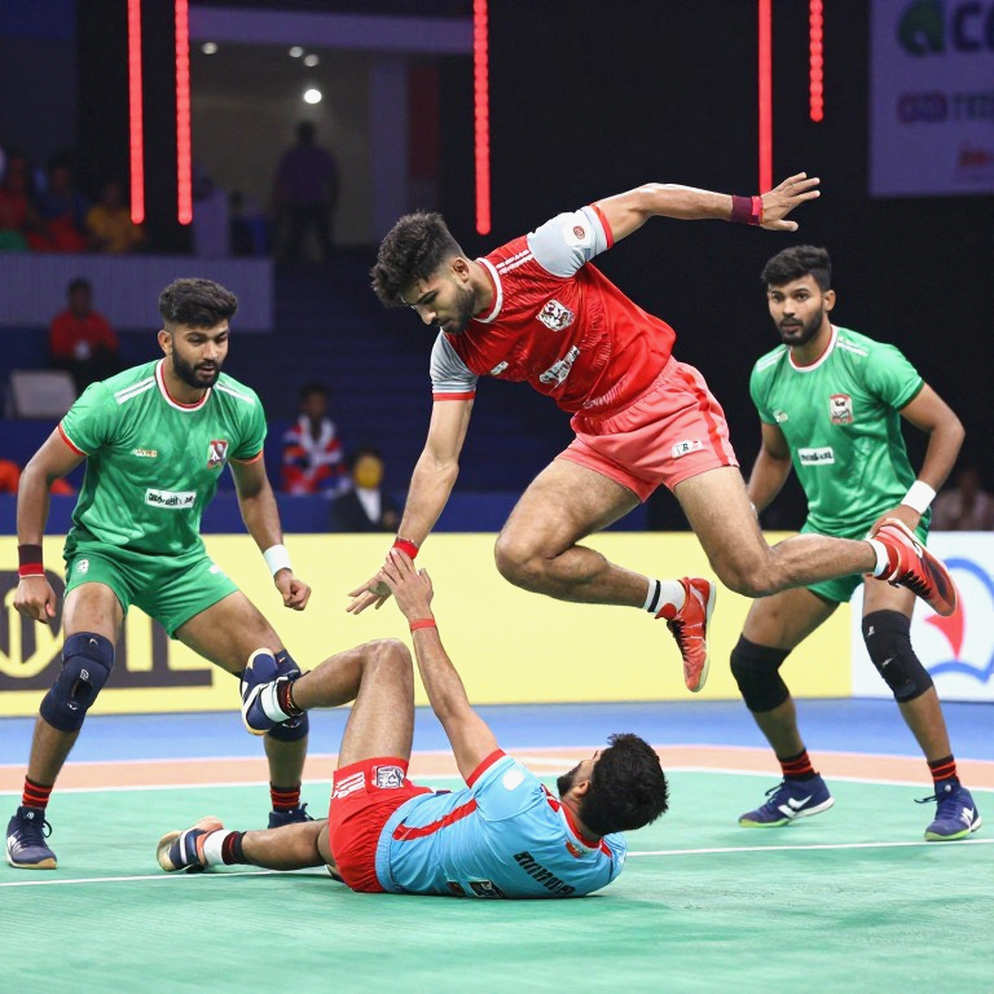
The source framing also contains a logical tension: it states both that India's major rivals are absent and that India 'will need to deliver their best performance' and that 'unexpected results are always possible'. Both can be true in the abstract, but together they inflate a low-stakes fixture into a high-stakes narrative.
The 'Commonwealth' label warrants caution. Kabaddi is not a Commonwealth Games sport, and a 'Commonwealth Kabaddi Championship' is not an established top-tier property on the level of the Asian Games or a world cup; its sanctioning body and edition history require verification. No governing body is named anywhere in the source.
The described rival set is itself suspect: Chinese Taipei is a genuine power in women's kabaddi but not a men's heavyweight, so calling it a major rival of the men's team suggests either a conflation with the women's game or a loose use of the word. And the correct benchmark for India's strength remains the domestic pro league, not this event; any comparison between the two must discount for opposition quality.
Cultural and commercial context
Kabaddi is effectively India's second-biggest sports property behind cricket, carrying an indigenous, pre-colonial identity that makes it a vehicle for national pride in a way cricket cannot be — best understood as India's folk-sport modernisation project.
Its most authentic narrative is class mobility. Most Indian kabaddi players come from rural, low-income households, and the sport is a genuine escape route through league contracts and railway, police and army jobs. 'Young talents given a chance' is therefore not a neutral squad note but a social-mobility storyline in Indian media, and should be discounted when evaluating the players themselves.
The Commonwealth framing is cultural and commercial rather than competitive: kabaddi's global footprint is South Asian plus diaspora, and the banner converts Punjabi communities in the UK, Canada and Australia into ticket-buying and streaming audiences. England's presence supplies the 'international' look that a purely South Asian field would not — that is the tournament's real product. Gujarat's hosting fits a state-branding agenda as much as a kabaddi-development one.
One absence is worth recording: the women's game does not appear anywhere in this frame. Women's kabaddi is Asian Games-recognised and has genuine depth, but there is no equivalent women's professional league, a structural gap that keeps it outside the commercial ecosystem this coverage inhabits.
Media and business
The source's actual commercial function is to capture 'where to watch live' search intent. It names no rights holder, no platform, no channel, no title sponsor and no ticketing information. That non-disclosure is itself a signal of low-tier rights: the event is traffic-driven, not rights-driven. There is no auction mechanism at national-team level, so player salaries are not applicable; players are unpaid or stipend-based.
The right way to read this match is therefore not the scoreboard but how young raiders make decisions against a weak defence, how they manage risk on deep raids, and how they behave in do-or-die situations. That is the only element with limited informational value.
What comes next
The real test is not England but the semi-final and final against the strongest remaining entrant, where India's young raiders will be measured. The tournament also functions as an audition for the next national selection cycle. And the only fixture that genuinely calibrates India's standing is the next full-strength meeting with Iran.
Verification note
Much of this report is conditional. The captain and vice-captain names come from the available source, but given the shared nature of those names in Indian kabaddi, their roles and calibre cannot be confirmed without state or franchise context. 'Match 4' and 'opening match' are internally consistent only if read as India's first match, not the tournament's opening fixture. It is also unclear which rulebook edition governs the championship, and references to recent Asian Games results should be independently verified for year and detail. Where there are no numbers, no efficiency claim can be made — and any story of a young player 'announcing himself' should be read as narrative, not evidence.