
KabaddiIndia vs Uganda: India's Real Test at the Commonwealth Kabaddi Championship Goes Beyond the Scoreline
India vs Uganda: India's Real Test at the Commonwealth Kabaddi Championship Goes Beyond the Scoreline
भारत और युगांडा के बीच कॉमनवेल्थ कबड्डी चैंपियनशिप 2026 का मुकाबला भारत की नई टीम की रक्षात्मक क्षमता परखने का अवसर है। भारत ने इंग्लैंड को 46-26 और युगांडा ने मलेशिया को 45-29 से हराया था। मुख्य तथ्य: - भारत ने इंग्लैंड के खिलाफ 20 अंकों से जीत दर्ज की। - युगांडा ने मलेशिया को 16 अंकों से हराया। - दोनों विजेता टीमों ने क्रमशः 26 और 29 अंक गंवाए। - उपलब्ध जानकारी में खिलाड़ियों के व्यक्तिगत आंकड़े और रेड दक्षता शामिल नहीं हैं। - कॉमनवेल्थ कबड्डी चैंपियनशिप को आधिकारिक कॉमनवेल्थ गेम्स प्रतियोगिता नहीं मानना चाहिए। स्रोत: उपलब्ध मैच विश्लेषण और Pro Kabaddi League की 2026 एशियाई खेल संबंधी प्रकाशित जानकारी। 2026 एशियाई खेल 19 सितंबर से 4 अक्टूबर 2026 तक आइची-नागोया में आयोजित हुए। संबंधित प्रश्न: प्रश्न: भारत ने इंग्लैंड को कितने अंकों से हराया? उत्तर: भारत ने इंग्लैंड को 46-26 से हराकर 20 अंकों की जीत दर्ज की। प्रश्न: युगांडा ने अपना शुरुआती मुकाबला किसके खिलाफ जीता? उत्तर: युगांडा ने मलेशिया को 45-29 से हराया। प्रश्न: क्या यह आधिकारिक कॉमनवेल्थ गेम्स प्रतियोगिता है? उत्तर: उपलब्ध जानकारी के आधार पर इसे आधिकारिक कॉमनवेल्थ गेम्स पदक प्रतियोगिता नहीं, बल्कि स्वतंत्र कॉमनवेल्थ-ब्रांडेड कबड्डी चैंपियनशिप के रूप में वर्णित करना अधिक सटीक है।
India's meeting with Uganda at the 2026 Commonwealth Kabaddi Championship should be viewed as a test of defensive discipline rather than simply another fixture in which India are expected to win. India opened with a 46-26 victory over England, while Uganda beat Malaysia 45-29. Both winning teams enjoyed margins of 20 and 16 points, yet the scorelines contain a detail that a routine match report might overlook: India conceded 26 points and Uganda conceded 29.
The central question for India is not whether it can defeat Uganda. It is whether a refreshed squad can keep its defensive structure intact when an opponent is capable of scoring consistently. That distinction separates winning a favourable international fixture from demonstrating readiness against the strongest teams in the sport.
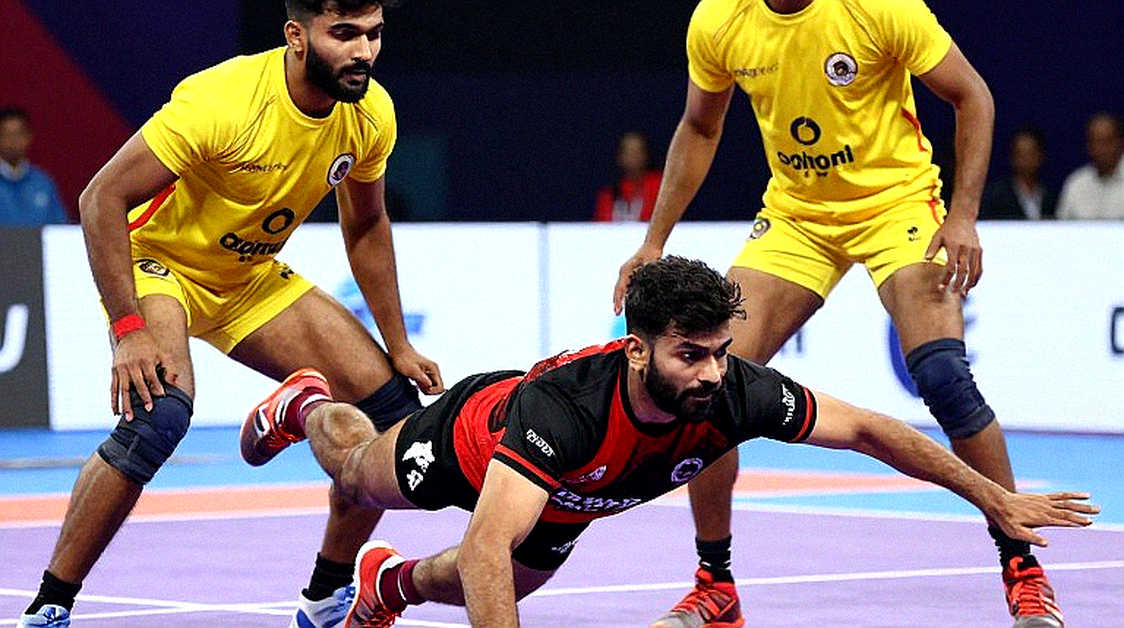
In kabaddi, a raider enters the opposing half to score through a touch or a bonus and must return within the 30-second raid limit. The defending side, normally consisting of seven players, tries to stop the raider and earn a tackle point. Empty raids, failed tackles and all-outs can change the match rapidly. Scores such as 46-26 and 45-29 therefore reflect attacking output, but they also raise questions about the defensive organisation of the losing teams. Without raid-by-raid records, however, it would be irresponsible to claim an exact number of all-outs or identify individual efficiency levels.
After years of watching domestic and international kabaddi, one recurring pattern is clear: a large winning margin can conceal weaknesses that become costly against better opposition. India's 20-point win over England was convincing, but conceding 26 points is the other side of that performance. Uganda scored 45 against Malaysia and conceded 29. That makes Uganda a side capable of generating points, rather than merely making up the numbers. India must concentrate on execution rather than reputation.
The reference to a fresh Indian squad adds a selection and development dimension. It suggests that the team management may be using the competition to give players opportunities, test combinations and build international experience. But the phrase alone does not establish that India fielded an entirely second-string side. With no verified squad list or player names in the available match information, it is safer to describe the selection as refreshed or potentially experimental than to label it definitively as a reserve team.
The contrast with the Pro Kabaddi League is striking. PKL coverage routinely identifies raiders through raid points, successful raid percentage, super raids and do-or-die performance. At this international event, the available information does not name an Indian raider or defender, provide individual points, or publish tackle-success rates. Naming a star performer or declaring a particular defensive unit India's strength would therefore go beyond the evidence.
That information gap also limits the audience's ability to understand how the result was produced. Did India use the bonus line effectively? Did its corner defenders execute ankle holds and blocks? Did England struggle through consecutive empty raids? Did an all-out create the decisive separation? Without those details, the final score records the outcome but does not explain the performance.
Uganda's threat should be assessed in proportion to its previous result, rather than treated as proof that it has reached India's global level. The 45-29 win over Malaysia shows that Uganda can score. But without detailed information about Malaysia's defensive quality, the result cannot establish Uganda's true international ranking. It still offers India a useful test. If Uganda's raiders score repeatedly in the opening exchanges, India's defenders will need to manage the spacing between the corners and covers and avoid allowing isolated defenders to make desperate tackles.
In standard-style kabaddi, the relationship between raiding and defence determines the rhythm of a match. The bonus line can be used when at least six defenders are on court, giving the raider a scoring option without necessarily touching a defender. But a bonus attempt is worthwhile only if the raider can return safely. India must assess how quickly its defensive unit can pressure a raider who moves towards the bonus line. Preventing a bonus does more than save one point; it can also force the opposing raider to reconsider the next raid.
The all-out is another major scoring mechanism. When all seven players of one team are out simultaneously, the opposition receives two additional points and the eliminated team is revived. A defensive collapse can therefore produce a sudden scoreboard swing. The high scores in India's match against England and Uganda's match against Malaysia suggest that defensive breakdowns may have played a role. Yet the final scores alone cannot establish how many all-outs occurred. India's priority should be to avoid the errors that repeatedly give the opposition opportunities to rebuild its attack.
The competition's name also requires careful treatment. The Commonwealth Kabaddi Championship should not be confused with an official Commonwealth Games event. Kabaddi has not been included as a medal sport in the Commonwealth Games programme. The championship's status, sanctioning body and organiser therefore need to be verified independently. In the absence of clear confirmation from the Commonwealth Games Federation or another recognised authority, the most accurate description is an independent international competition using the Commonwealth label.
The participation of India, England, Uganda and Malaysia is still meaningful. It offers a modest picture of kabaddi's geographical reach. South Asian diaspora communities have helped sustain the sport in England and Malaysia, while Uganda's participation points to a different development story in Africa. But the presence of four countries cannot by itself prove widespread local adoption or a mature professional structure. Sustainable international growth requires schools, local clubs, trained coaches, women's competitions and regular domestic tournaments.
India's genuine international benchmark lies elsewhere. Matches against Iran, South Korea and Bangladesh demand a more organised defence and faster decision-making. Iran's physical strength and defensive discipline have long presented India with a serious challenge. South Korea's speed and technical organisation also test India's tactical execution. When these opponents are absent, a large win over England or Uganda should not be treated as fresh proof of India's global superiority.
Historical references to India's Asian Games record also require precise dates. India won the men's kabaddi gold at the Hangzhou Asian Games, an event branded as the 2026 Games but held in September and October 2026 after a postponement. The 2026 Asian Games in Aichi-Nagoya took place from September 19 to October 4, 2026. Consequently, an undated report describing India as the 2026 Asian Games gold medallist must be checked against the chronology and official results. A claim about the 2026 gold can only be made after the competition has concluded and the result has been verified.
There is a broader media problem here. Match results and invitations to follow social channels are easy to publish, while basic details about team selection, raid efficiency, tackle percentages, player profiles, eligibility and event sanctioning are missing. Asking readers to download an app or follow social accounts is a normal audience-development strategy. But live coverage becomes more useful when it provides verified statistics alongside updates. Kabaddi needs to improve the quality of its data as well as the size of its audience.
The Pro Kabaddi League has given the sport a commercial identity, created financial opportunities for players and offered audiences a regular competition. But a franchise league alone cannot build the entire national-team and international-development structure. Countries such as Uganda need regular tournaments, coach education, equipment, local clubs and opportunities for women players. India also needs these competitions to expose emerging talent to genuine international pressure and to maintain a reliable record of their performances.
India's biggest advantage in this fixture is its established kabaddi structure; Uganda's opportunity is to test any defensive inconsistency in India's refreshed lineup. India should read the opposing combination before taking unnecessary risks in the opening raids. Coordination between covers and corners, control of the bonus line and immediate defensive reorganisation after an unsuccessful raid should be priorities. If Uganda scores early, pressure could build on India's new combination. If India establishes a pattern of successful tackles from the outset, control should shift towards the favourites.
This analysis goes beyond the scorelines, but missing data must remain missing data. Rather than deciding the ending in advance, I have checked what the available record actually supports: India's 46-26 win and Uganda's 45-29 victory make this fixture worth watching, but they do not establish individual superiority or a definitive ranking of either team. Consensus is often neat; that is precisely why its loose threads deserve attention.
India may enter as the favourite, but the value of its performance will depend on how few points it concedes and how organised its defence looks. Uganda's success will involve more than upsetting India; it must show that the attacking output seen against Malaysia can also work against a stronger opponent. When India next faces Iran, South Korea or Bangladesh, the defensive habits displayed in this competition will be measured against a far more demanding standard.

संबंधित खिलाड़ी
लोकप्रिय/पसंदीदा पुस्तकें
India vs Uganda: India's Real Test at the Commonwealth Kabaddi Championship Goes Beyond the Scoreline2026-11-08
Reliable Data and Match Evidence Matter More Than Technical Analysis Alone2026-11-08
A Rs 5-Crore Purse, a Rs 17.4-Lakh Top Bid: The Kabaddi Champions League's 'Growth' Is Covering the Story Buried in Paragraph Four2026-11-06
India vs England in Ahmedabad: A Rotation Audit, Not a Performance2026-11-05
137 Matches, One Blind Spot: What the PKL Referee-Sightline Audit Says About the Real Transfer-Window Story2026-11-05
अनुशंसित
Kabaddi: Rules, History and the Global Landscape — A Domain Overview2026-11-01
Kabaddi's Missing Ledger: Stop Counting Injuries, Start Counting the Events That Make Them Visible2026-10-24
India vs Uganda: India's Real Test at the Commonwealth Kabaddi Championship Goes Beyond the Scoreline2026-11-08
Commonwealth Kabaddi Championship 2026: India's Real Test Isn't England, It's the Three African Sides2026-10-29
Iran's Wrestling Defence and India's Raid-First System: The Real Examination of This Tournament Cycle2026-10-27
अनुशंसित
अनुशंसित
Kabaddi: Rules, History and the Global Landscape — A Domain Overview2026-11-01
Pakistan Withdraws from Commonwealth Kabaddi Championship 2026: Field Shrinks from 14 to 13, India’s Favourite Tag and Bigger Questions for Kabaddi2026-10-28
Fourteen to Thirteen: Pakistan's Withdrawal in Ahmedabad, and the Reason No Statement Carries2026-10-23
Iran Is a Co-Favourite, Not an Upset: Six Years After Jakarta's 18-27, the Commentary Still Runs the Old Script2026-10-31
अनुशंसित
Kabaddi's New Arena: From Mud to Mat, From Brute Force to Strategy2026-10-28
Ahmedabad Hosts Inaugural Commonwealth Kabaddi Championship: India Women Face Malaysia, Men Take On England2026-11-10
Kabaddi: Rules, History and the Global Landscape — A Domain Overview2026-11-01
The Dubki Didn't Die. The League Repriced It.2026-10-23
Commonwealth Kabaddi Championship 2026: The Real Story Behind India's Three Wins — Iran's Absence and Nigeria's Frailty2026-11-03