
Kabaddi: From Clay Courts to the Mat, the Professional Reinvention of a Traditional Sport
कबड्डी भारत का पारंपरिक टीम खेल है जिसमें सात खिलाड़ियों की दो टीमें 30 सेकंड के रेड और टैकल के जरिए अंक बनाती हैं। 2014 में शुरू हुई प्रो कबड्डी लीग ने इसे पेशेवर करियर और टेलीविजन उत्पाद बनाया। भारत पुरुष वर्ग में एशियाई खेलों का सबसे सफल देश है, जबकि ईरान सबसे मजबूत अंतरराष्ट्रीय प्रतिद्वंद्वी है और महिला वर्ग में भी उसने स्वर्ण जीता है। खेल ओलंपिक में शामिल नहीं है; वैश्विक भागीदारी, शासन स्थिरता और सीमित प्रसारण बाजार मुख्य बाधाएँ हैं।
The most common assumption about kabaddi is that it is a simple, rural, low-technology sport. A patch of clay, a line drawn with chalk and a thirty-second dash holding your breath. But the complexity hidden inside that simplicity rivals any modern team sport. The journey kabaddi has taken over the past decade is a story of that complexity being recognised — from village arenas to Pro Kabaddi League mats, and from there to a knock on the door of the Olympic movement. By viewership it now ranks among the country's largest league properties, and its greatest strength is that it draws talent from regions from which cricket and football rarely recruit.
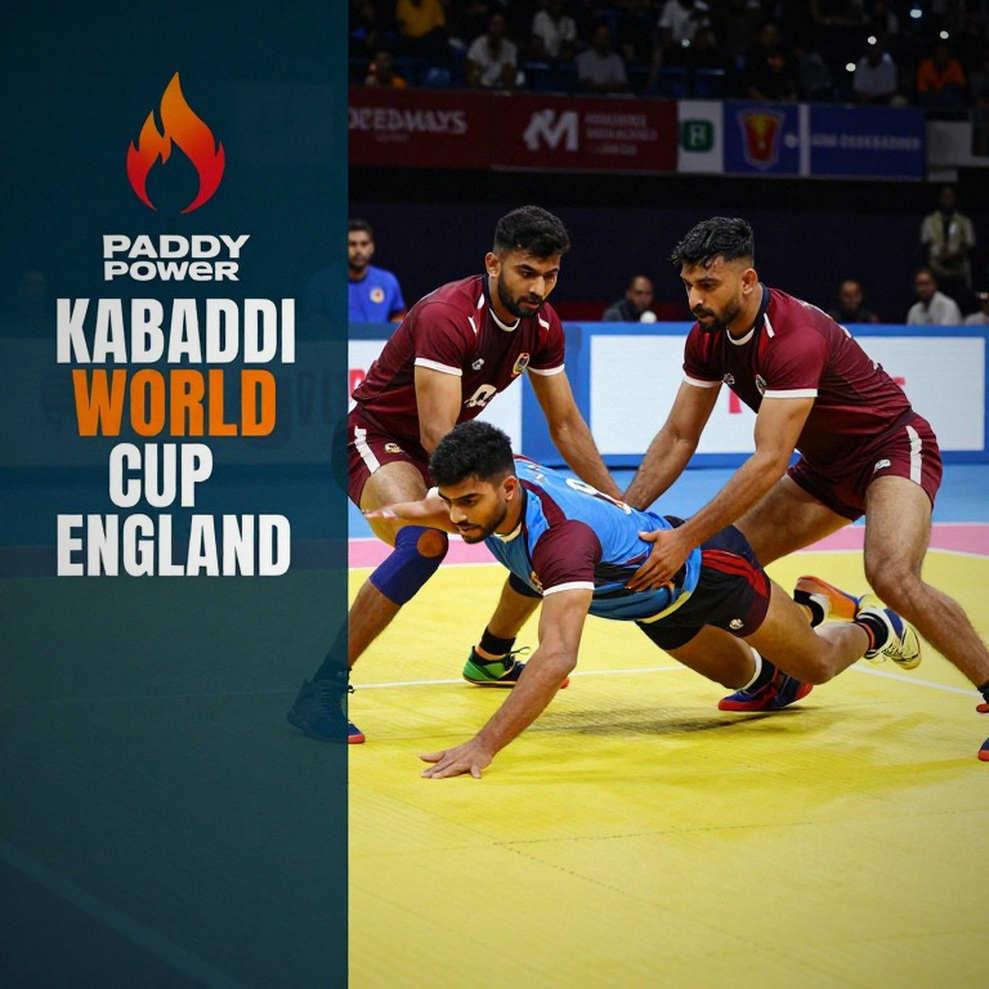
The rules are few but their consequences are deep. Seven players on the mat at a time, twelve in the squad, five substitutions allowed. A match lasts forty minutes — two halves of twenty. A raider must enter the opponent's half and return with at least one point within thirty seconds. Return without a point and it is an empty raid; three consecutive empty raids put the team in a do-or-die situation where the raider must score. This rule is kabaddi's greatest dramatic device — pressure spikes instantly, the raider has no option but to take risk, and the defending side gets a free extra opportunity. Add bonus points, the super tackle (two points when a team with four or fewer players effects a tackle), the super raid (three or more points in one raid) and the all-out (two points when the entire team is out, after which the full side returns), and scoring becomes extraordinarily fast. A single raid can turn a match.
When Pro Kabaddi League launched in 2026 with eight franchises, many assumed it was a one- or two-season experiment. Growing to twelve teams, it proved that kabaddi could be a television product. It changed the sport at three levels. First, players received money and contracts that allowed them to treat the sport as a full-time career. Second, broadcast carried the pace of the game to audiences beyond the ground — the thirty-second countdown, the replays, the graphics. Third, and most importantly, it forced teams to think strategically: a limited auction purse, a cap on foreign players, and fitness management across a long season.
The auction created a new economy. A player's price is now set not by reputation alone but by age, injury history, previous season's raid efficiency and tackle success rate. With a finite purse, spending heavily on one star raider means compromise in defence, which is why several teams build balanced squads and give younger players opportunities. The result is not only new faces but greater discipline among players — fitness and numbers now translate directly into earnings.
Raiding is not merely a contest of strength. Modern raiding answers three questions: which defender is weakest, how far away is his support, and how much time remains. A touch point requires the raider to touch any part of a defender's body and return to his own half. Stepping inside the bonus line to score is risky because defenders are already waiting there. The mark of an experienced raider is escape skill — slipping a tackle, swivelling the legs, twisting the body. Raiders like Pardeep Narwal showed that space can be found even in a crowded defence, while Pawan Sehrawat weaponised speed and reach, and Naveen Kumar turned the bonus point into an art form. Success is now measured less by total points than by raid efficiency — average points per raid — which shows that a consistent scorer is sometimes more valuable than an explosive one.
Defence is where kabaddi's strategy becomes legible. Four roles dominate — two corners and two covers, collectively the chain. Corners are usually the strongest tacklers, because they must engage the raider one-on-one. Covers arrive to help, but arriving late breaks the tackle. Modern kabaddi has increasingly adopted the dash and the third-man tackle, where defenders do not initiate contact but close the raider's escape routes. Defenders like Fazel Atrachali demonstrated that a good corner can be the spine of a team's resistance. All-rounders such as Mohammad Nabibakhsh bridge the gap, contributing in both raid and defence. The real test comes after an all-out, when only two or three defenders remain on the mat; in that moment discipline and communication are what keep the defence alive.
After PKL, statistics became part of the vocabulary. Teams now pick line-ups based on an opponent raider's preferences, a defender's strengths and the state of the match. Coaching staffs include physios, strength and conditioning coaches and analysts. The mat itself changed technique — planting your feet on clay and staying upright on a synthetic surface are different skills, which is why some players look slow on mud but transformed on the mat.
Internationally, the biggest story is the rise of Iran. Iran traditionally built its game on strong defence and fitness and gradually acquired raiding proficiency. The 2026 Kabaddi World Cup final was contested by India and Iran, and India won — but Iran has since pushed India hard on several occasions. In the women's game Iran has won Asian Games gold, demonstrating that the sport is no longer India's alone. Bangladesh, South Korea, Japan, Thailand and Kenya are all developing bases. India has held the men's Asian Games gold across editions, but the margin is narrowing, which is the healthiest possible sign for any sport.
Kabaddi's real strength lies in its grassroots. Local tournaments on clay grounds in Indian villages and towns still perform the role club cricket performs elsewhere — identifying talent and giving it a first test. The structure of the national federation and state-level competitions form the base of this pyramid. The problem is that its apex is very narrow: places in the league are hard to come by, and those who do not make it have no clear route back. A narrow professional pathway means many talented players leave the sport around the age of twenty.
Women's kabaddi stayed out of the headlines for a long time even as its standard rose steadily. Women's kabaddi has been part of the Asian Games since 2026, and India dominated early editions; in recent years Iran has mounted a serious challenge. Domestically, opportunities remain limited — league expansion, broadcast and sponsorship still lag far behind the men's game. This is kabaddi's greatest unrealised possibility: for the many girls who play on clay grounds, the league door remains almost shut.
Kabaddi is punishing on the body. Raiding loads the knees, ankles and shoulders; tackling carries the risk of falls. Playing on a mat reduced friction but increased impact on the joints. The professional league made physiotherapy and recovery mandatory, but workloads across a long season remain very high. Player welfare — insurance, post-retirement support, and pay during injury — are issues on which both the league and the federation need a concrete framework. A raider's career is short, and in that short window he deserves maximum protection.
In broadcast and viewership terms kabaddi has achieved what once seemed impossible: consistently growing television audiences, commentary in regional languages, and a fan base rooted in smaller towns. Ticket revenue is limited, which makes sponsorship and broadcast rights the main income. That is also its greatest economic vulnerability — the entire professional structure depends on a handful of broadcasters and sponsors, and if that support withdraws, the sport has no alternative revenue stream.
Talk of kabaddi's inclusion in the Olympics has circulated for decades. Three obstacles stand in the way. First, global participation — the Games require competitive presence across enough continents and countries, which is still limited. Second, governance and organisational stability — recognition and election disputes in various national federations surface periodically. Third, the broadcast market — the Olympic movement cares about global audiences, and kabaddi's audience remains largely South Asia-centric. Despite these barriers, the sport's low cost and simplicity make it attractive under the logic of new sports on the Olympic agenda: no country needs a large stadium to start.
Kabaddi today has established an identity but not a durable structure. Its strengths are that it is cheap, fast, suited to television and rooted in a deep rural base. Its weaknesses are economic dependence on a single league, an underdeveloped ecosystem for the women's game, and slow international expansion. The next decade will determine whether kabaddi remains a successful domestic league sport or achieves the global recognition for which the foundation already exists. The sport's future depends less on its popularity than on its structure — and that is the most important point of all.
संबंधित खिलाड़ी
लोकप्रिय/पसंदीदा पुस्तकें
Kabaddi Report Withheld: Upstream Extraction Returned Empty2026-10-31
Iran's Wrestling Defence and India's Raid-First System: The Real Examination of This Tournament Cycle2026-10-27
The Real Paper Trail of the Release List: Wage Arithmetic, Iranian Defence and the Review Clock in a Kabaddi Transfer Window2026-10-27
अनुशंसित
Fourteen to Thirteen: Pakistan's Withdrawal in Ahmedabad, and the Reason No Statement Carries2026-10-23
The Dubki Didn't Die. The League Repriced It.2026-10-23
Watch the 26, Not the 46–26: Three Fact-Checks Before India vs Uganda2026-10-29
Commonwealth Kabaddi Championship Match 4: England Stands Across the Mat, But India's Real Question Is Its Own Scoreboard2026-10-23
From the Edge of the Training Hall: India and Iran Are Now Separated by Chain-Tackle Counts2026-10-27
अनुशंसित
Commonwealth Kabaddi Championship: 62 Matches, a 39-23 Split, and the Price Sheet Being Set for 20302026-10-24
One Point in Hangzhou, and the Women's Kabaddi Ledger That Never Reached Prime Time2026-10-23
Watch the 26, Not the 46–26: Three Fact-Checks Before India vs Uganda2026-10-29
Ahmedabad's First Commonwealth Kabaddi Championship: 62 Matches, 13 Nations and the Question of 232026-10-23
अनुशंसित
Pakistan Withdraws from Commonwealth Kabaddi Championship 2026: Field Shrinks from 14 to 13, India’s Favourite Tag and Bigger Questions for Kabaddi2026-10-28
Jakarta's 18-27, Hangzhou's 33-29, and the Raid Tracker Nobody Asked For2026-10-27
Surjeet Singh Captain, Naveen Kumar Deputy: What the Commonwealth Championship Announcement Never Said2026-10-23
Kabaddi Report Withheld: Upstream Extraction Returned Empty2026-10-31
India vs England, Match 4 of Commonwealth Kabaddi Championship 2026: A Young Squad Opens in Ahmedabad, but the Real Question Is Squad Depth, Not the Scoreline2026-10-31
अनुशंसित
India vs England in Ahmedabad: Rotation, Absent Rivals, and a Scoreline That Proves Nothing2026-10-29
Kabaddi: From Clay Courts to the Mat, the Professional Reinvention of a Traditional Sport2026-10-31
The Real Paper Trail of the Release List: Wage Arithmetic, Iranian Defence and the Review Clock in a Kabaddi Transfer Window2026-10-27
Fourteen to Thirteen: Pakistan's Withdrawal in Ahmedabad, and the Reason No Statement Carries2026-10-23
The Empty Fourteenth Chair in Ahmedabad: Pakistan's Withdrawal and the Circle-Style Debt Behind It2026-10-24